
The Echo of the Within
When we gaze up at the night sky, we do not merely see scattered stars or an endless void; we are, in truth, looking into an ancient mirror. And when we close our eyes to dive into the depths of our own consciousness, we are not withdrawing from the world, but entering a miniature version of it.
The question that has puzzled philosophers since the dawn of time, and kept physicists awake in modern laboratories, is not merely “What is the universe made of?” but rather, “Why does the universe feel so familiar to our minds?” Are we simply fleeting observers in a cold, indifferent cosmic theater? Or are we and the universe woven from the same fabric—an unbroken thread where consciousness is not a biological accident, but the very essence of matter trying to understand itself?
In this journey, we will not speak of the universe as a place we inhabit, but as a state we experience. We will attempt to decode this uncanny resemblance between what occurs within the neurons of our brains and what unfolds in the nebulae of distant galaxies. It is a journey into the “essence of meaning,” where science meets meditation, and physics becomes a new language for the spirit.
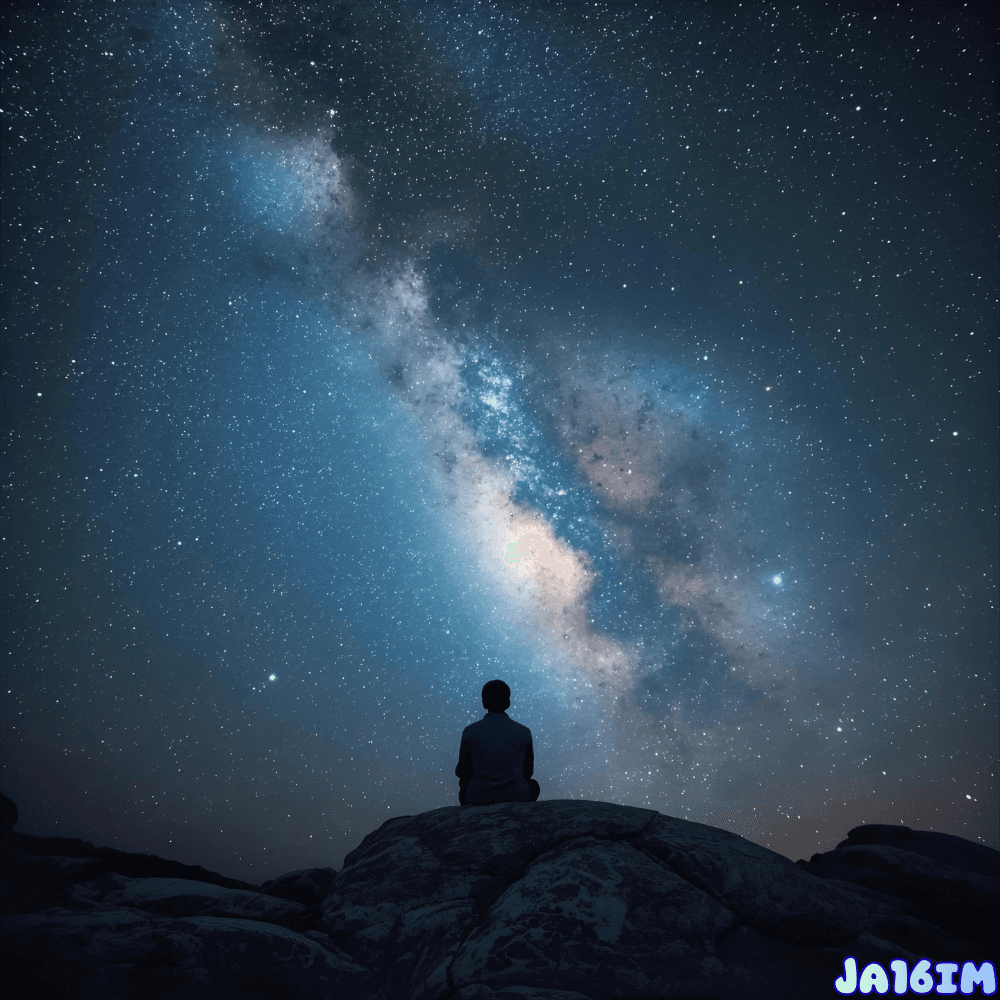
The Universe and Consciousness: Primal Concepts of Resemblance
If we contemplate the structure of existence, we find that nature repeats itself with breathtaking precision. The ancient Hermetic principle, “As above, so below,” is no longer just mystical wisdom; it has become a reality observed through telescopes and microscopes alike.
The universe and consciousness share a fundamental characteristic: Expansion and Connection. The universe is in a state of constant expansion, birthing new galaxies, new energy, and new pathways for light. Similarly, human consciousness is in perpetual expansion; every new thought, every realization, every emotional experience adds a new “galaxy” to your inner universe.
The only difference lies in the tool; the universe uses gravity to bind its parts, while consciousness uses “Meaning.” Meaning is the gravity of the soul. Without it, our thoughts and experiences would scatter like drifting cosmic dust. When we grasp this similarity, we realize we are not insignificant compared to the cosmos, for infinity is not measured by size, but by depth. The human mind is the black hole that consumes the light of knowledge to transform it into wisdom.
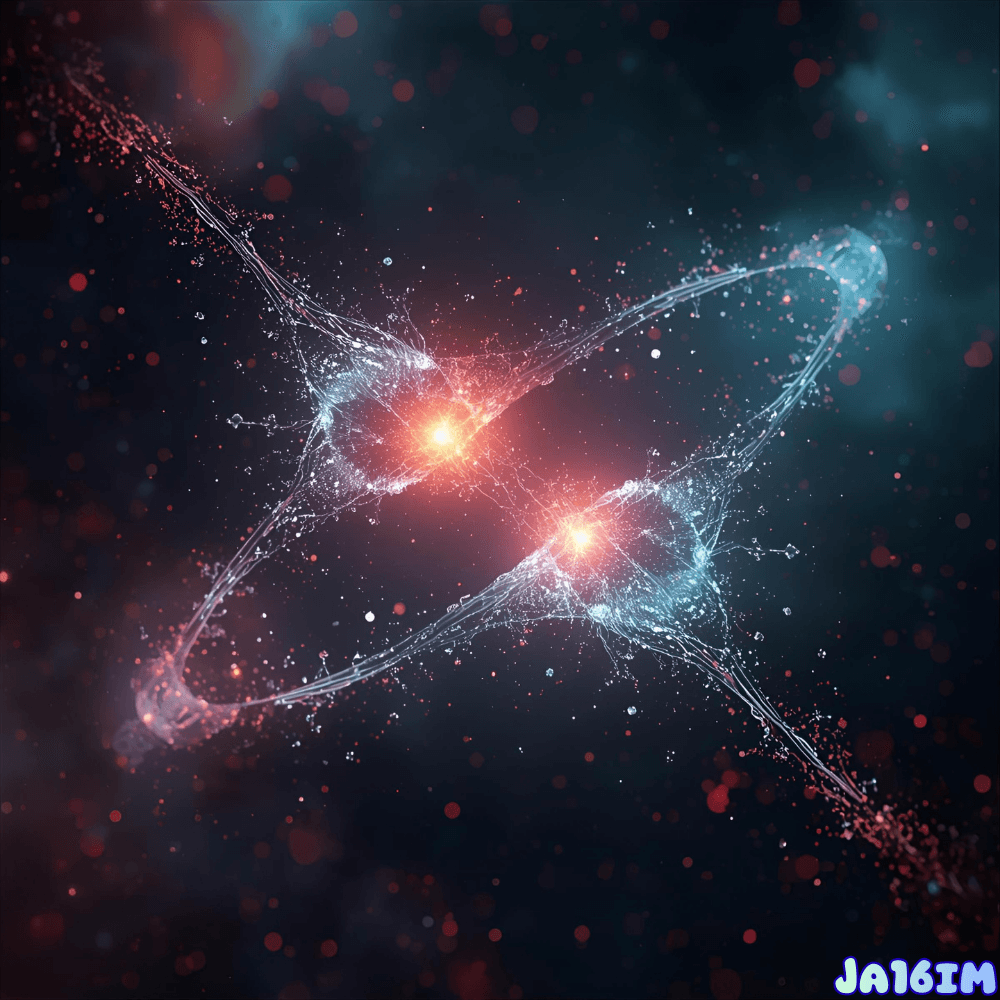
Quantum Entanglement: Particles Communicate… Does the Brain?
At the heart of quantum mechanics lies a phenomenon that breaks all rules of classical logic: Quantum Entanglement. When two particles become entangled, they remain linked by an invisible bond that transcends space and time. If you change the state of one, the other responds instantly, even if it resides on the other side of the galaxy. Einstein famously called this “spooky action at a distance.”
But does this “magic” apply only to electrons and photons? Modern science is beginning to ask a bold question: Does human consciousness operate by the same mechanism? Is that “intuition” telling you a loved one is in danger, or that moment you think of a friend just before they call, merely a coincidence? Or is it a form of biological quantum entanglement?
If everything in the universe is energy, and our brain is a generator and receiver of energy, it is logical to assume our brains can “entangle” with others, or even with the energetic field of the universe itself. Here, consciousness does not function as an isolated device inside the skull, but as a transceiver in an infinite cosmic network. Love, empathy, and the feeling of oneness with nature may not just be chemical emotions, but a “state of entanglement” where the distance between “Self” and “Other” dissolves, returning us to the singular source from which we all emerged.
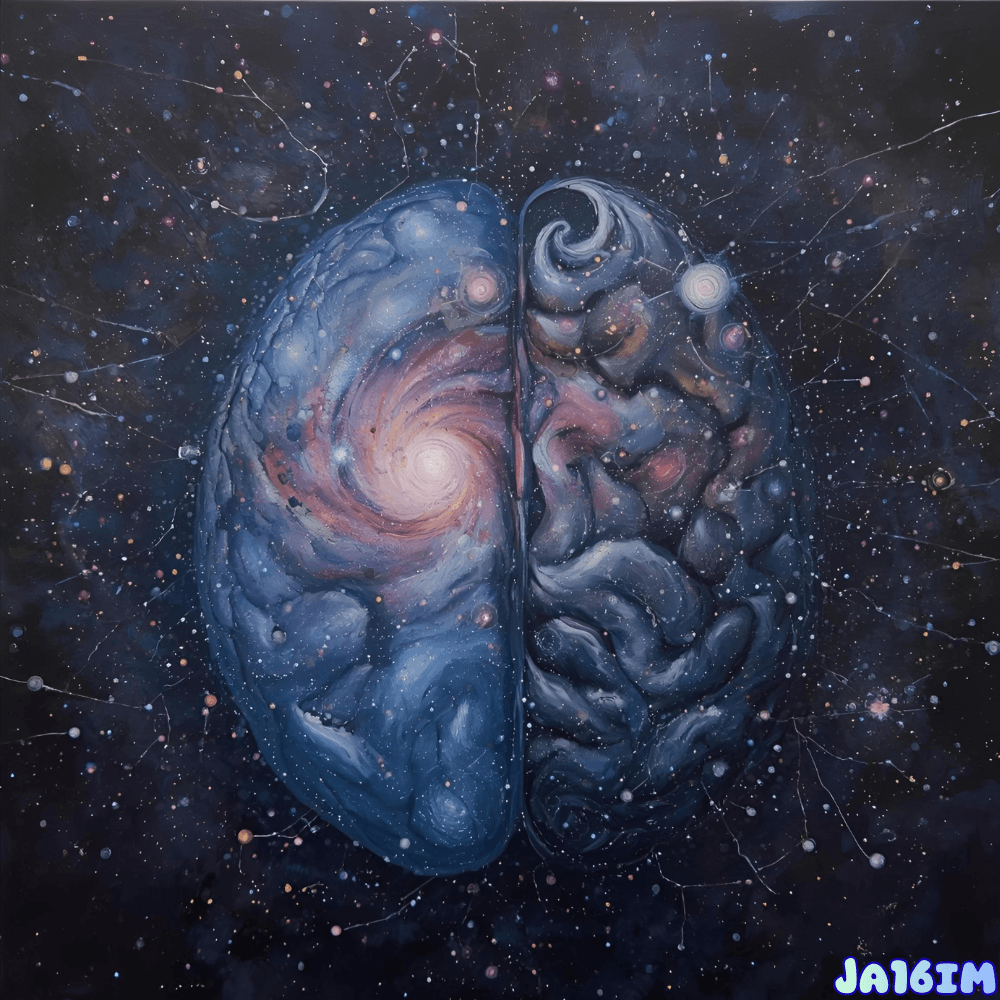
Brain Networks and Cosmic Webs: Is There a Shared Pattern?
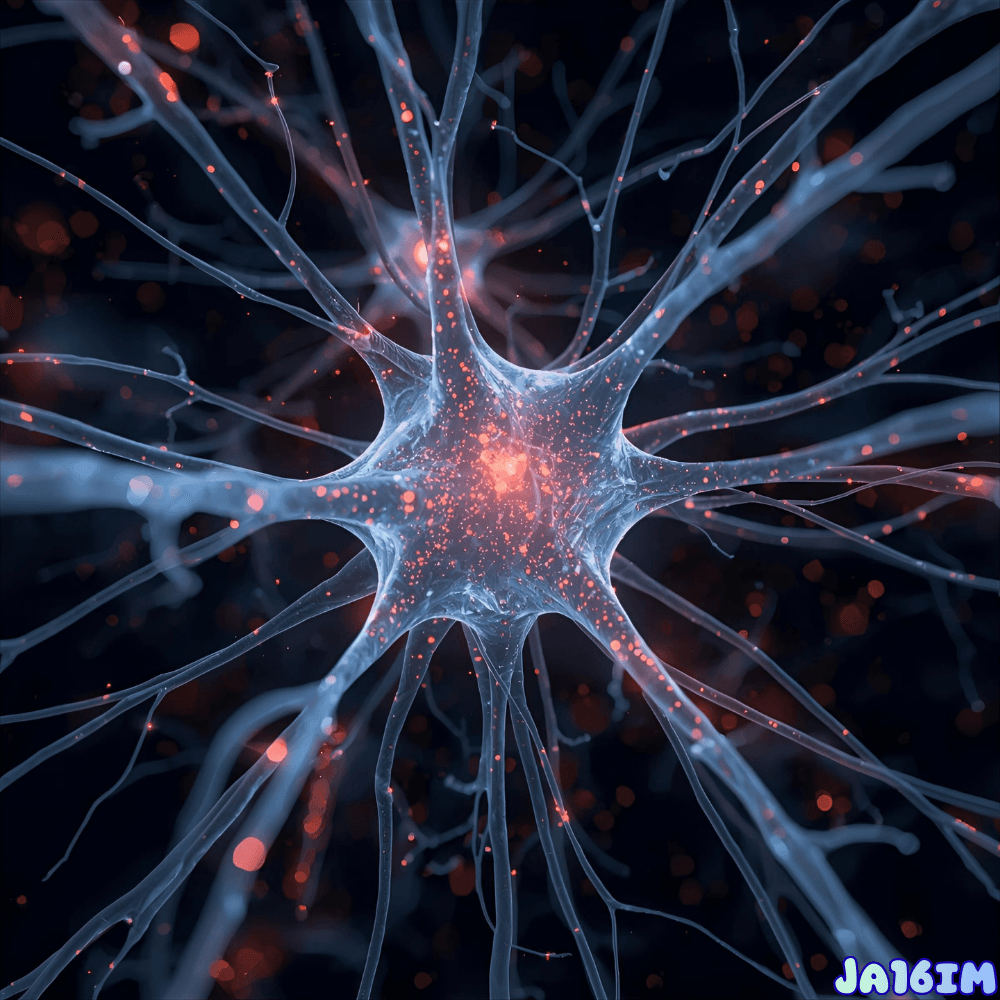
In 2020, a team of astrophysicists and neuroscientists made a startling comparison. They placed a map of the human brain’s neural network alongside a simulation of the “Cosmic Web” that connects galaxies across the universe. The result was striking. The images were nearly identical.
- In the Brain: Billions of neurons connect via axons, transmitting electrical signals to create consciousness.
- In the Universe: Billions of galaxies connect via filaments of dark matter and gas, transmitting energy and gravity to create the cosmic structure.
This visual and mathematical resemblance is not random. It suggests there is a “hidden law of growth” governing everything, from the smallest thought-cell to the largest galaxy cluster. It is as if the universe is trying to build a “giant brain,” and we are its neurons. Or perhaps the human brain was designed to be a “micro-universe,” capable of comprehending the macro-universe.
This shifts our perspective entirely. You are not a being living in a network; you are part of the network. Your thoughts are electrical pulses rippling through this grand fabric. When you think, you are not just talking to yourself; you are sending ripples into the cosmic web, just as a galaxy sends its light through the ages. We and the universe follow the same “sacred geometry” of connection and creation.
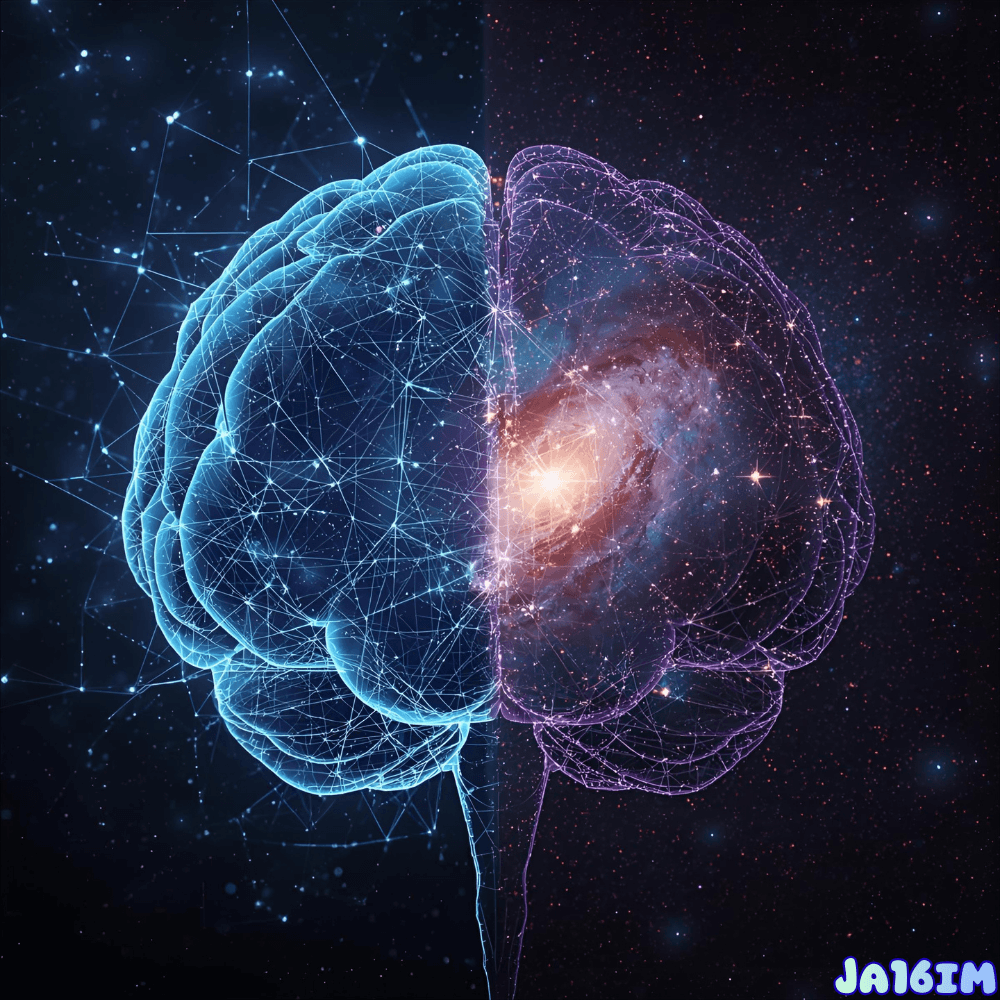
Brain Waves vs. Cosmic Energy Waves
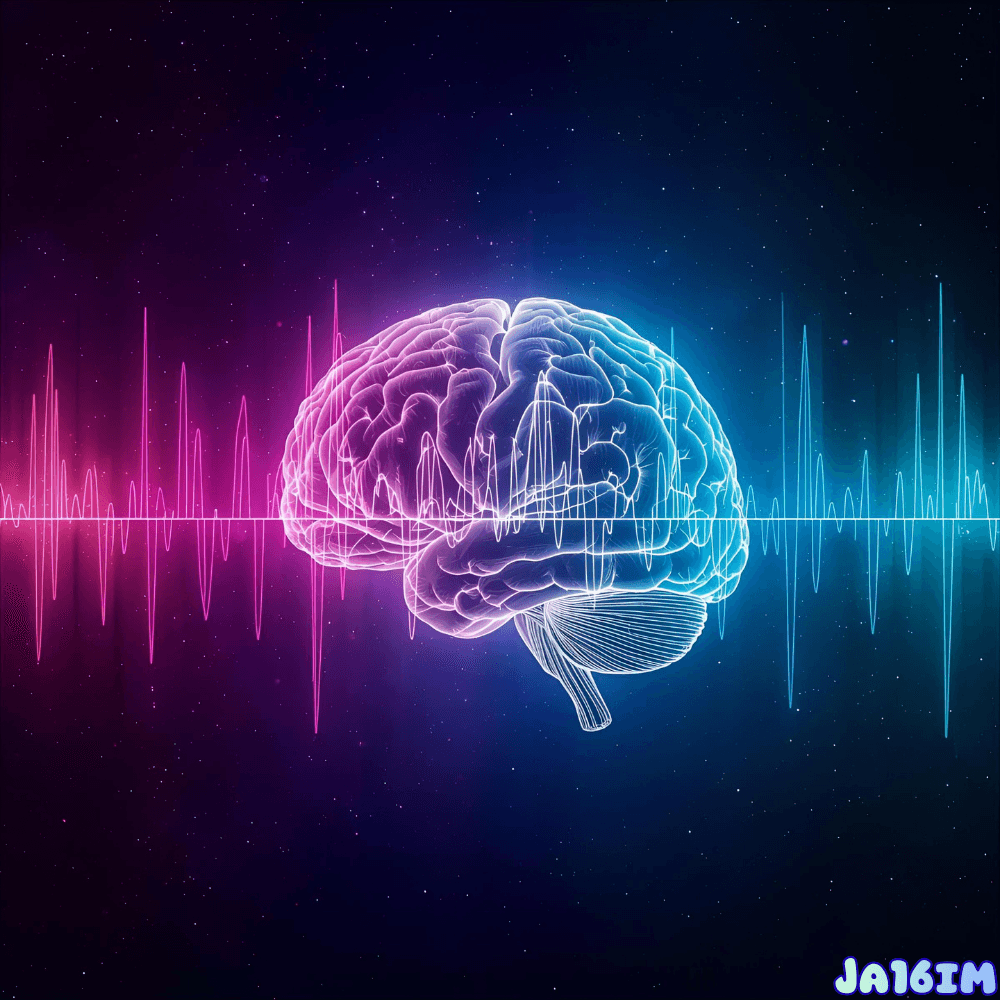
Everything in existence vibrates. There is no absolute stillness. The human brain operates through specific frequencies (Alpha, Beta, Theta, Gamma, Delta). Each frequency represents a state of consciousness, from sharp alertness to deep meditation or sleep.
On the other side, the universe sings its own song. Earth itself has an electromagnetic pulse known as the Schumann Resonance, with a base frequency of 7.83 Hz. The astonishing paradox lies here: This frequency (7.83 Hz) falls precisely within the range of “Alpha” and “Theta” waves in the human brain. These are the waves responsible for deep relaxation, creativity, and healing.
What does this mean? It means our natural state—the state of calm and balance—is actually a state of synchronization with the pulse of the planet and the cosmos. We are biologically designed to be on the same “wavelength” as nature. Stress, anxiety, and modern noise are forms of “dissonance” that pull us out of this cosmic rhythm.
Cosmic consciousness, then, is not an abstract philosophical concept, but a physical process of “Resonance.” When you enter deep meditation, you are not escaping reality; you are tuning your brain’s frequency to match the universe. In that moment of alignment, boundaries fade, and one feels absolute peace… because one has returned home.
Time and Perception: How Does the Universe Reflect Within?
If you ask a physicist about time, they will speak of the fourth dimension and the warping of space-time around massive objects. If you ask a clock, it offers only cold, ticking numbers. But if you ask Consciousness, the answer is entirely different.
As we explored in The Essence of Meaning, “Time is not measured by hours, but by the meanings we weave within it.” This is not merely poetic; it is a reality supported by neuroscience and relativity. In the cosmos, time is “relative”; it slows down near extreme gravity or speed. In our consciousness, time is “elastic”; it stretches when we suffer, vanishes when we love, and condenses when we realize a truth.
The universe and the human mind share this ability to “fold time.” Human memory, for instance, is not a static archive of the past; it is a quantum time machine. When you remember, you do not retrieve a dead event; you biologically and emotionally recreate it in the present. The brain collapses the temporal distance, much like a wormhole collapses spatial distance in the cosmos. We do not live in a linear progression from past to future. We live in the “Eternal Now,” where the past is memory, the future is potential, and consciousness is the focal point that gathers the entire universe into a single moment of perception.
Synchronized Consciousness: Shared Experiences Beyond the Self
Have you ever felt a sudden pang of anxiety, only to discover later that a loved one was in distress at that exact moment? Or have you observed how flocks of birds move as a single entity, with a singular mind, absent of any visible leader? Science studies these phenomena under names like “Collective Unconscious” (Carl Jung) or “Morphogenic Fields” (Rupert Sheldrake).
The universe knows no true separation; the space between us is not empty, but filled with energy fields that connect us. Human consciousness might not be “private property” locked inside the skull, but rather akin to a cosmic “Cloud” service. We are all connected to an invisible biological Wi-Fi.
Experiments in “Synchronized Consciousness” suggest we are not isolated islands, but waves in a single ocean. When the consciousness of a group elevates (in collective prayer, deep meditation, or even during global crises), measurable effects are observed in random number generators around the world (as seen in the Global Consciousness Project). This leads to a staggering hypothesis: Are we cells in a larger cosmic brain? Is our individual awareness merely a “window” through which the universe looks at itself? Love and empathy, in this sense, are not just emotions, but “physical forces” of binding, akin to the gravity that holds planets together.
Ancient Philosophy: Hermes, Hinduism, and Buddhism
Long before modern science discovered holograms and networks, the sages of the East and West arrived at these truths through the “laboratory of meditation.”
- Hermes and the Cosmic Principle: “As above, so below. As within, so without.” This ancient Hermetic axiom is the perfect summary of the “Holographic Universe” theory. It tells us that the atom mirrors the solar system, and the human eye resembles the Helix Nebula. The ancients understood that the universe repeats its pattern on every scale, and the key to understanding the cosmos lies in understanding the Self.
- Indra’s Net (Hinduism and Buddhism): Ancient texts speak of “Indra’s Net,” an infinite web of jewels where every jewel reflects all the other jewels in the universe in its polished surface. Is this not a precise description of Quantum Entanglement and multidimensionality? Every human mind is a “jewel” in this net, reflecting the cosmos within. “Maya” (illusion) is the belief that we are separate, while “Nirvana” (enlightenment) is the realization that we and the universe are one.
These philosophies were not myths; they were “intuitive sciences.” They saw with the “inner eye” what we now see with the electron microscope. They understood that consciousness is the ground of being, and meditation is not an escape from the world, but an awakening to its reality.
Modern Physics and Consciousness: Where Does Perception Come From?
Here we arrive at the “Hard Problem” of modern science. How does a subjective experience (the taste of chocolate, the feeling of sadness, seeing the color red) arise from wet, gray matter inside a skull? Classical physics failed to explain it, leading quantum physics theories to propose a revolutionary solution: Consciousness is not a product of matter; it is the foundation of matter.
Theories like “Orch-OR” (proposed by physicist Roger Penrose and anesthesiologist Stuart Hameroff) suggest that consciousness arises from subtle quantum processes inside the “microtubules” within brain cells. This implies our brain functions as a “quantum computer” interacting with the fabric of the universe at its most fundamental level.
If this is true, consciousness exists everywhere, from the electron to the galaxy, but in varying degrees. We do not “create” consciousness; we “receive” and amplify it. The brain is like a radio receiver; it picks up the cosmic music, but it is not the musician playing it. This explains why artists and creators often feel ideas “come to them” rather than being made by them; in moments of clarity, they tune their frequency to receive the broadcast of cosmic consciousness.
Flow State and Cosmic Connection
Have you ever been so immersed in a task—painting, writing, running, or even meditating—that you completely forgot yourself, lost track of time, and felt as though you were exerting no effort, but rather that the action was simply “flowing” through you? Psychologists call this the Flow State. But from a cosmic perspective, it is more than just heightened focus; it is a moment of “Ego Neutralization.”
In our ordinary state, the brain acts as a strict gatekeeper, filtering reality and constantly asserting: “I am here, this is mine, this is separate from me.” This is the self-consciousness that divides us from the universe. However, in the state of “Flow,” this voice falls silent (specifically, activity in the prefrontal cortex decreases). Suddenly, the barriers are removed. There is no longer a “painter” and a “painting”; the two become a single entity in the act of creation.
In that moment, we are not separate from the universe; we become a channel for it. Cosmic energy, usually obstructed by the noise of our thoughts and fears, finds an open path to move through us. True genius creativity is not so much personal fabrication as it is “allowing” the universe to express itself through your instruments. When you are in Flow, you resonate with the rhythm of existence, shifting from a “separate being” to a “harmonious wave” in the ocean of energy.
Energy and The Field: How Does the Universe Connect Us?
Look at your hand. It seems solid, doesn’t it? Physics tells us the exact opposite. Your hand, your body, and everything you touch are made of atoms that are 99.9999% empty space. What remains is not solid “matter,” but vibrating energy. We are not material beings living in an empty universe; we are condensations of energy within a unified cosmic field.
This “Field” is the invisible web that connects us all. When you walk into a room and suddenly feel a “heaviness” or “tension” without anyone speaking, you are not imagining it; you are reading the energetic field of the space. When you feel immediate comfort with a stranger, it is a harmony of frequencies between your field and theirs.
We exchange information with the universe and each other constantly, not through words, but through vibrations. The human heart, for example, generates an electromagnetic field that can be detected several feet outside the body. Thus, we “touch” each other with our energetic fields long before we shake hands. Separation is an optical illusion; on the energetic level, we are interlaced like the colors of a rainbow, dissolving into one another and into the total light that contains us.
Direct Perception vs. Language: How Do We Touch the Universe with Our Mind?
Language is humanity’s greatest invention, but it is also the greatest prison for consciousness. Words are “labels,” not “truths.” The word “tree” is not the tree; it is merely a phonetic symbol pointing to it. When we view the world through language, we see it through “filters.” We say, “This is a beautiful tree,” classifying and judging it, and in doing so, we lose direct contact with its living reality.
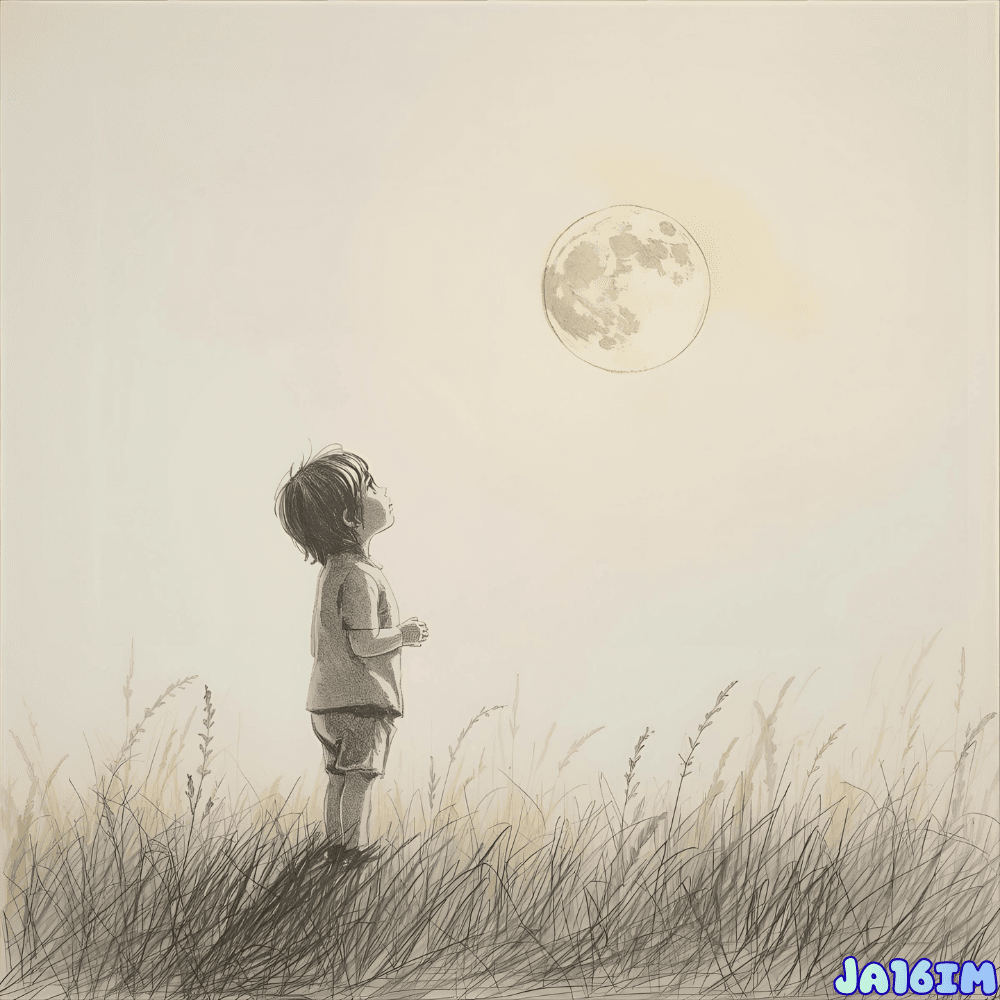
The universe does not speak English or Arabic; it speaks the language of “Direct Being.” To communicate with the cosmos, we must shift from “Verbal Consciousness” (thinking in words) to “Direct Perception” (silent witnessing). Consider a child looking at the moon for the first time. They do not say, “That is a moon, it is spherical, it orbits the Earth.” They simply see, marvel, and unite with the scene through their heart. This is the “Beginner’s Mind” of Zen.
When we drop language and drop judgment, we touch the “essence of things.” We see the universe as it is, not as our dictionaries describe it. In that moment of inner silence, the mind becomes capable of holding cosmic truths that words are too narrow to contain. Cosmic knowledge is not information to be read; it is a state of presence to be lived.
The Mind as a Mirror of the Universe: Brains Speaking for the Cosmos
We return to the idea of the “Mirror.” If the universe took 13.8 billion years to evolve from cosmic dust to stars, from stars to planets, from planets to life, and from life to consciousness… what was the goal? The renowned physicist John Wheeler proposed the idea of a “Participatory Universe”; the universe requires observers to become real.
In other words: We are the eyes through which the universe sees itself. We are not intruding guests; we are the method by which the cosmos realizes its existence. Through your mind, the universe contemplates its beauty. Or through your heart, the universe experiences love. Through your questions, the universe explores its mysteries. The human brain is the most complex structure known in the universe, and it is the most polished mirror nature has produced to reflect its own grandeur.
The higher your consciousness rises, the purer the mirror becomes, and the clearer the image in which the universe sees itself. You are not just a “person” trying to understand the universe; you are the Universe trying to understand itself through the human form. This truth alone is enough to dissolve every feeling of loneliness or insignificance, filling the soul with the awe of belonging to this magnificent existence.
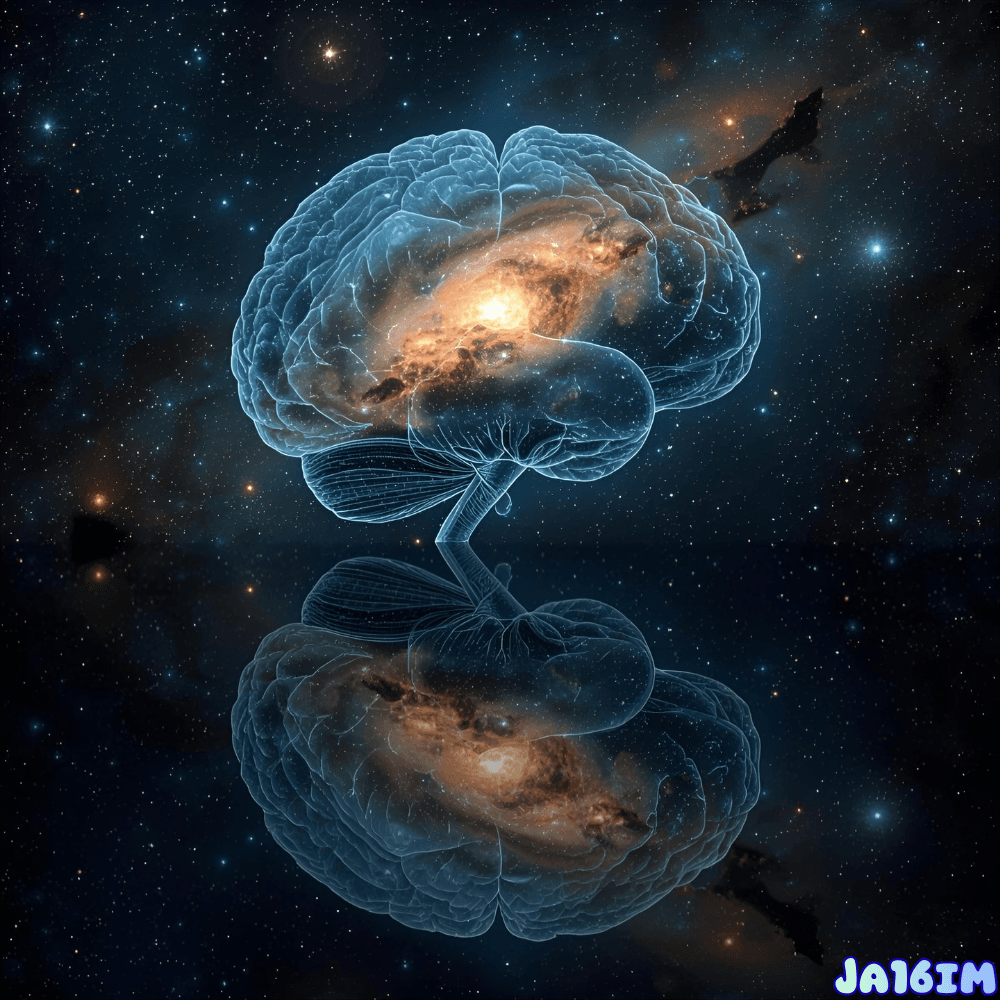
The Impact of Meditation and Cosmic Consciousness on the Brain: Re-engineering the Self
For a long time, scientists believed the brain was a static organ once adulthood was reached. However, the discovery of Neuroplasticity turned this view upside down. The brain is not a rigid machine; it is an ever-changing river
Reshaping its pathways based on what we do, what we think, and most importantly: how we meditate.
Modern studies using fMRI have proven that deep meditation does not merely calm the nerves; it literally changes the “physics of the brain.”
- Shrinking of the Amygdala: The center responsible for fear and stress, thereby reducing our sense of separation and threat.
- Thickening of the Prefrontal Cortex: The area responsible for higher awareness, decision-making, and empathy.
What does this mean cosmically? When a human practices “Cosmic Consciousness”—sensing their connection to everything around them—they are literally “upgrading” their receiver. They transform their brain from
A primitive device focused on survival (fear, conflict) to an advanced instrument focused on ascension (unity, love). Meditation is a delicate process of Calibration, enabling the brain to withstand higher frequencies of consciousness
Much like upgrading electrical wiring to handle more power. Through silence, we build the antennas that catch the wisdom of the universe.
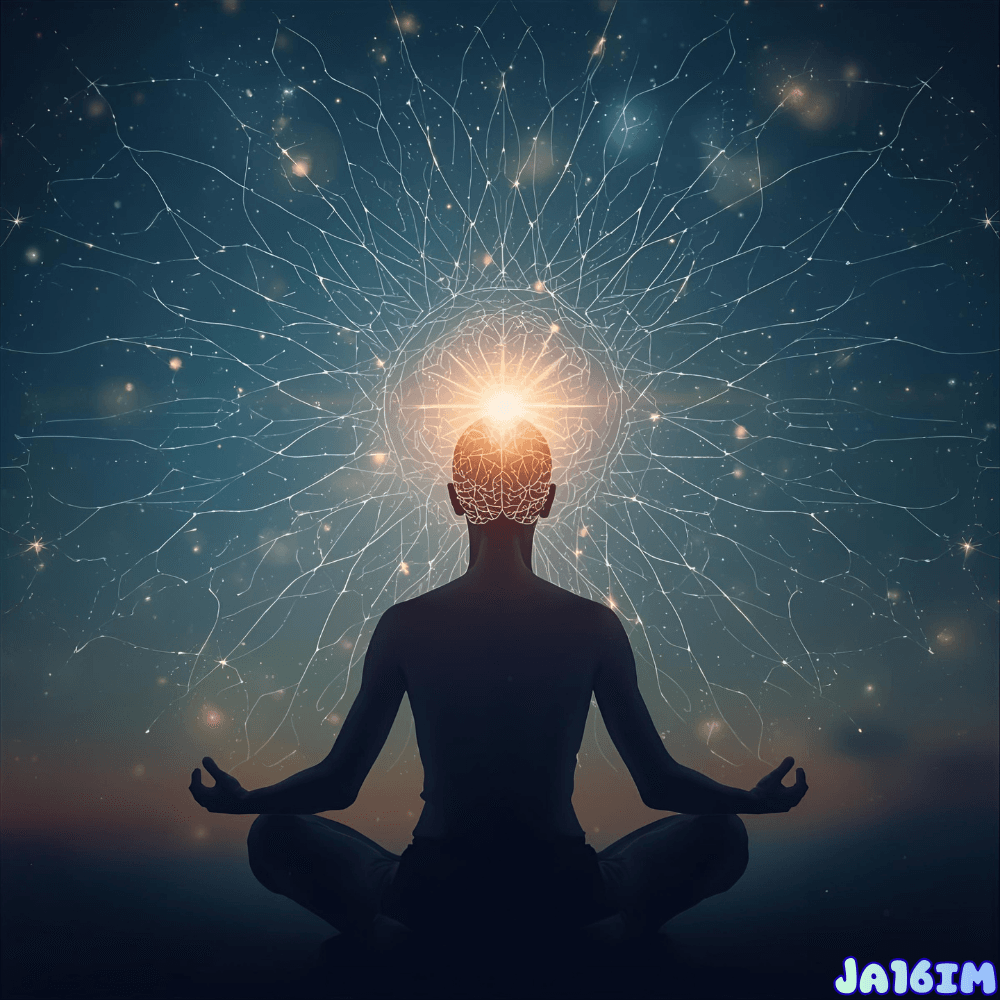
Mind and Space: Can Humans Become “Small Conscious Planets”?
If the universe is expanding, and consciousness is expanding, are there limits to what we can become? The philosopher Teilhard de Chardin spoke of the “Noosphere,” or the “sphere of human thought,”
A layer of consciousness enveloping the Earth just like the atmosphere. In this vision, every human is not merely an individual being but a “point of light” in a planetary web of consciousness.
Imagine your mind as a small planet; it has its own gravity (your thoughts attract your reality), its own orbit (your routines and habits), and its own atmosphere (your energetic aura). When human consciousness rises, its “gravity of meaning” increases. One’s mere existence becomes influential to those around them without words. One becomes a “planet” around which events revolve in harmony, not by chance. We are moving toward a stage where humans may become aware not only of their bodies but of their extension in space. We may not be planets of rock and gas, but planets of “perception.” And when these human planets align, they form a “galaxy of consciousness” capable of altering the destiny of the Earth.
Scientific Challenges and the Future of Consciousness: The Limits of Measurement
Despite all progress, science stands baffled before the “Measurement Problem.” We can measure brain waves, but we cannot measure the “experience of love”
Or the “ecstasy of cosmic connection” with material devices. “Qualia”—the purely subjective experience—remains the puzzle that protects the secret of the soul.
The scientific future is now heading toward “Non-local Consciousness.” Advanced institutes like IONS are studying telepathy, remote viewing, and the effect of intention on matter. The question is no longer “Does consciousness affect matter?” but “To what extent?” We are approaching an era where technology might merge with spirituality;
Not to implant chips in heads, but to use technology to prove what mystics have known for millennia: That we are One. Humanity’s future may not lie solely in colonizing Mars, but in colonizing “Inner Space,” discovering that the dimensions of consciousness are vaster and richer than the dimensions of outer space.
Conclusion: The Human as a Link Between Matter, Energy, and Consciousness
At the conclusion of this long journey, from the atom to the galaxy, and from the neuron to the nebula, we return to the first question: Who are we?
We are not random biological accidents floating on a rock orbiting an average star. Or we are the Universe awake. We are the moment matter decided to see itself, hear its own voice, and feel its own existence. The human brain is the miracle where the worlds of Physics (energy and matter) meet the worlds of Metaphysics (meaning and spirit).
You are the Bridge. Your foot is planted in the mud of the Earth (Matter), your head touches the ceiling of the Sky (Consciousness), and your heart is the transformation point that blends the two to create “Meaning.” Your role in this existence is not merely to “survive,” but to be the “Clear Mirror” reflecting cosmic light, and to be the “Conscious Observer” who transforms chaos into order, pain into wisdom, and silent existence into a song of meaning.
The connection between you and the universe is not theoretical; it is written in every atom of your body, and in every flash of your mind. You are not in the universe… The universe is in you.
Writing and Contemplation: Jassim Alsaffar
Digital Identity: Ja16im
A contemplative artist and philosophical writer exploring the symbolism of perception and meaning through digital art, bilingual books, and contemplative scientific articles.
- Limits of Human Cognition: Why Truth May Be Beyond the Mind
- Limits of Human Cognition: Cognitive Closure and Hidden Reality
- The Event Horizon of the Mind: What the Brain Cannot Imagine
- Beyond Earth: Can Humanity Become an Interstellar Species?
- The Final Sunset: What Happens to Humanity When the Sun Dies?
