
The Duality of Mind vs. Consciousness: Who Is Really in Control? A Scientific and Philosophical Journey
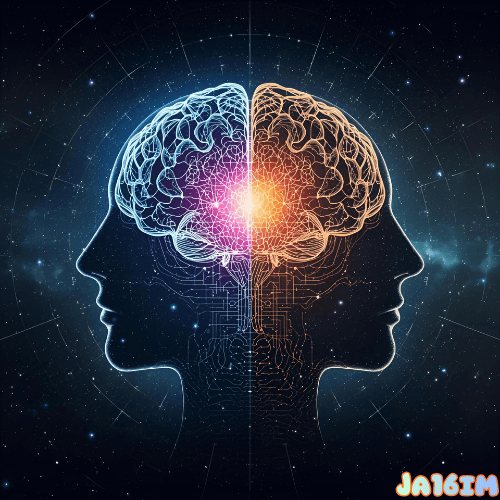
A silent struggle defines the human experience. It is a battle between two distinct forces. First, the “Mind” attacks with its incessant noise and analysis. Second, “Consciousness” observes with a silent presence. Philosophers have debated this duality for centuries. However, modern science is now peeling back the biological layers of this distinction. Are we merely the product of mechanical neural processes? Or is there an independent “observer” that possesses veto power? The answer determines if we live as biological machines or as entities with free will.
“The mind is a wonderful servant but a terrible master. Consciousness is the space where you realize you are not the tool.”
The Mind: The Autopilot and the Default Mode Network
Scientifically, we can describe the “Mind” as a set of cognitive functions. These include thinking, memory, and emotion, which arise from neural activity. The mind’s primary function is survival. Therefore, it tends to operate on an evolutionary “autopilot.”
Neuroscience highlights a significant discovery regarding this: the Default Mode Network (DMN). This network activates when we do not focus on a specific task. Consequently, it drives “mind-wandering.” Furthermore, it creates worries about the future and constructs the “Ego” narrative.
- Scientific Evidence: Studies link DMN hyperactivity to psychological disorders like anxiety. This happens because an unchecked mind scans for threats based on past data.
🔗 Scientific Source: The Default Mode Network and its Impact (NIH)
Consciousness: The Silent Observer and the “Hard Problem”
The Mind is a stream of thoughts. In contrast, Consciousness is the “screen” where these thoughts appear. Philosophers call this “The Hard Problem of Consciousness,” a term coined by David Chalmers. Science can explain *how* the brain processes information. Yet, it struggles to explain *why* we feel this as a subjective experience (Qualia).
Consciousness has distinct features that separate it from mental chatter:
- Metacognition: This is the ability to think about thinking. You might realize you are angry. The part recognizing that anger is not the emotion itself. Instead, it is the observant Consciousness.
- Present Presence: The Mind oscillates between past memories and future projections. Conversely, Consciousness exists exclusively in the present moment.
🔗 Philosophical & Scientific Source: Stanford Encyclopedia of Philosophy on Consciousness
Who Holds the Wheel? Libet’s Experiment and the Illusion of Will
A provocative debate in neuroscience surrounds Benjamin Libet’s experiments. Libet discovered that the brain prepares for movement milliseconds *before* the person is “consciously” aware of the decision. Consequently, many thinkers believed the subconscious Mind controls us. They argued that Consciousness is merely a “lagging observer.”
However, modern interpretations suggest a different role. Consciousness acts as “Free Won’t” (veto power). The automated Mind may propose an impulse. Nevertheless, conscious awareness possesses the capacity to “cancel” this action. Here lies true control.
🔗 Scientific Source: Nature Neuroscience Review on Free Will and Brain Processes
How to Regain Control? Neuroplasticity and Mindfulness
Control is not a fixed trait. Rather, it is a skill to acquire. MRI studies prove that “Mindfulness” leads to physical changes in brain structure. We call this neuroplasticity:
- Shrinking the Fear Center: Consistent practice decreases the volume of the Amygdala. This region drives instinctual “fight or flight” reactions.
- Thickening the Executive Center: Gray matter density increases in the Prefrontal Cortex. This area handles decision-making and emotional regulation.
Therefore, choosing “Consciousness” physically reshapes our brains. We become more sovereign and less subject to past programming.
🔗 Scientific Source: Harvard Study on Meditation and Brain Structure
Conclusion: The Conscious Partnership
We should not view this relationship as a war. Instead, we must see it as a partnership. The Mind is the excellent servant that analyzes data. Meanwhile, Consciousness is the CEO that sets the vision. However, problems arise when the CEO is absent. Then, the servant thinks it is the master.
True autonomy is simple: Use your mind. Do not let your mind use you.
Remember: Meaning is the journey itself, not the destination. And the meaning we create is what immortalizes us.
Writing and Contemplation: Jassim Alsaffar
Digital Identity: Ja16im
A contemplative artist and philosophical writer exploring the symbolism of perception and meaning through digital art, bilingual books, and contemplative scientific articles.
- Limits of Human Cognition: Why Truth May Be Beyond the Mind
- Limits of Human Cognition: Cognitive Closure and Hidden Reality
- The Event Horizon of the Mind: What the Brain Cannot Imagine
- Beyond Earth: Can Humanity Become an Interstellar Species?
- The Final Sunset: What Happens to Humanity When the Sun Dies?
