
When the Last Star Goes Dark: How Cosmic Death Reshapes Our View of Life
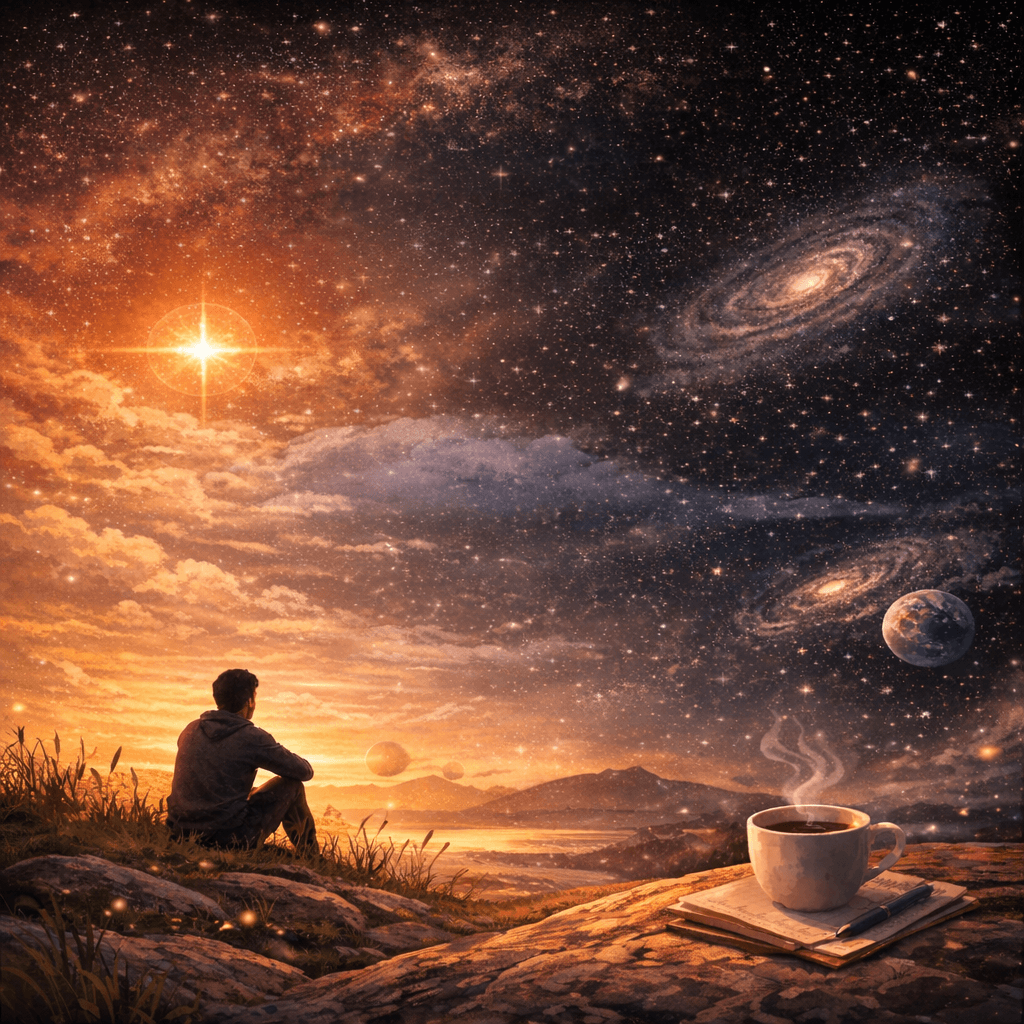
We wake up every morning, drink our coffee, and worry about electricity bills, traffic jams, and how others perceive us. We live as if these details are the center of the universe. But what if we swapped the lens? What if we looked at our lives not from the perspective of next week, but from the perspective of the next 100 trillion years?
Physics tells us a cold, inescapable truth: the universe is slowly dying. This is not a conspiracy theory; it is the Second Law of Thermodynamics. Entropy—chaos—always increases. Someday, the stars will consume their fuel and blink out, one by one. Every molecule will drift apart, and the cosmos will drown in an eternal, cold darkness known as the Heat Death.
“The awareness of inevitable endings doesn’t steal meaning from life; it condenses it. Things become precious precisely because they are temporary.”
Optimistic Nihilism: Freedom from Eternity
This scenario might seem profoundly depressing, triggering intense existential dread. If everything will eventually end—if every human achievement, from the Pyramids to Artificial Intelligence, will dissolve into cosmic oblivion—why try at all?
Here enters a modern and beautiful philosophical concept known as Optimistic Nihilism. The idea is simple: If the universe has no inherent ultimate purpose, and if its fate is oblivion, it means we are free.
You are not required to achieve some grand cosmic goal. You are not under the pressure to leave a legacy that lasts forever (because nothing lasts forever). This realization lifts the crushing weight of expectation from your shoulders. Failing at a business venture or enduring an embarrassing moment becomes laughably trivial against the backdrop of the Heat Death. The cosmic end gives us permission to live fully in the moment, because the moment is truly all we have.
The Rarity of Consciousness: Diamonds in the Coal
When we contemplate the end of the universe, we realize another stunning truth: We are living in the universe’s “Golden Age.” We exist in that incredibly narrow temporal window that allows for light, warmth, and consciousness.
Before us, the universe was too hot; long after us, it will be too cold. We are the exception. This makes your life, your awareness, and your ability to feel love or taste a strawberry, an exceedingly rare cosmic event. Thinking about the void that comes later makes us appreciate the “fullness” we experience right now. We are the mechanism through which the universe experiences itself before it sleeps forever.
Shifting Priorities: From “Survival” to “Experience”
How does daily life change with this realization? Priorities become clearer. Petty conflicts, grudges, and the endless pursuit of material possessions begin to look absurd. Instead, the focus shifts toward Experience and Connection.
- Forgiveness becomes easier: Why waste precious time in anger when we are all passengers on a ship that is very slowly sinking?
- Boldness increases: The fear of failure dissipates when you realize no one will remember your failures (or your successes) in a million years.
- Wonder returns: Your mere presence here, right now, breathing and thinking, is a mathematical probability approaching zero. You are a statistical miracle.
Conclusion: A Candle in the Dark
Thinking about the end of the universe is not an invitation to despair; it is a wake-up call. The approaching darkness makes the candle of our current life burn brighter and warmer. We do not possess eternity, but we do possess “Now.”
In the face of the great cosmic silence, the only logical response is to laugh, to love, to create, and to drink that coffee with complete enjoyment. Because, in this fleeting moment, we are the only light in this vast existence.
