
Holes in the Fabric of Reality: When Time Stops and Consciousness Bends
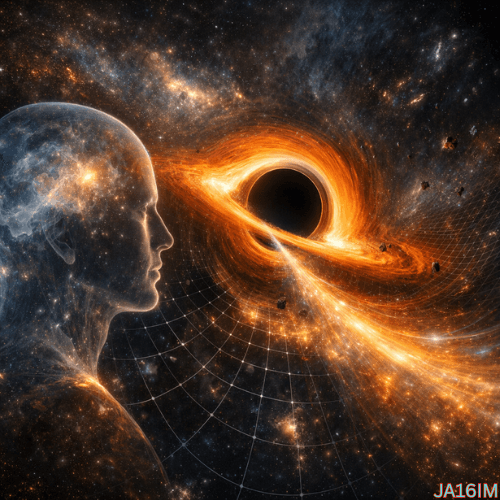
At the heart of every galaxy lies a dormant monster. It swallows light and returns nothing. Black holes are not merely strange celestial bodies. Instead, they are “glitches” in the cosmic operating system. They represent points where known physics cease to function and human logic collapses. Effectively, they form the edge where reality ends, and something else begins.
Historically, we viewed reality as fixed and stable. We believed time marches forward and space acts as a stage. However, the black hole mocks these constants. It ruthlessly demonstrates that “reality” is not solid. Rather, it is a flexible fabric capable of tearing, folding, and even stopping completely.
“A black hole is where God divides by zero. It is the eternal reminder that our understanding of the universe is but a thin crust over an ocean of mystery.”
Frozen Time: The Illusion of “Now”
Perhaps the most terrifying aspect of black holes is their relationship with time. At the “Event Horizon”—the point of no return—gravity becomes so intense that it drags time itself. Consequently, to an outside observer, a person falling into a black hole does not vanish instantly. Instead, they appear to slow down gradually. Finally, they freeze completely at the edge, becoming an eternal photograph.
Yet, for the person falling, time passes normally until the moment of spaghettification. This duality shatters our concept of “Now.” There is no single “Now” that encompasses the entire universe. Thus, black holes teach us that time is a purely subjective experience.
The Holographic Principle: Are We Just Data?
The study of black holes gave birth to a profound idea: the Holographic Principle. Physicists discovered that the hole does not destroy falling information. Instead, it imprints the data on its outer surface (the horizon) as two-dimensional code.
This discovery led to a seismic philosophical conclusion. If we can describe a black hole by data on its surface, perhaps the entire universe functions the same way. Is our “three-dimensional” reality merely a holographic projection? Ultimately, black holes hint that “matter” might be an illusion, and the true essence of existence is “information.”
The Singularity: A Mirror to Consciousness
In the center of the black hole lies the Singularity. Here, density becomes infinite and volume drops to zero. Furthermore, the laws of physics break down completely. There is no space, no time, just a “something” that defies description.
Surprisingly, is this not similar to human Consciousness? We possess an awareness at the center of our experience. Yet, we cannot locate it physically or measure it with material tools. Consciousness, like the singularity, acts as the point where matter (the brain) transforms into immaterial experience (feeling). Thus, perhaps black holes are the grand cosmic model for what happens inside our heads.
Conclusion: Standing on the Edge
Black holes are not just graveyards for stars. Rather, they are schools of philosophy. They teach us humility. They demonstrate that what we see is not all there is, and that time and space are not absolute.
When we contemplate black holes, we do not simply stare into the dark. Instead, we stare into the limits of the human mind. On that terrifying edge between existence and nothingness, we realize that reality is stranger, more beautiful, and more complex than any fiction humanity could ever invent.
- Limits of Human Cognition: Why Truth May Be Beyond the Mind
- Limits of Human Cognition: Cognitive Closure and Hidden Reality
- The Event Horizon of the Mind: What the Brain Cannot Imagine
- Beyond Earth: Can Humanity Become an Interstellar Species?
- The Final Sunset: What Happens to Humanity When the Sun Dies?
