
Journeys Beyond Biological Time
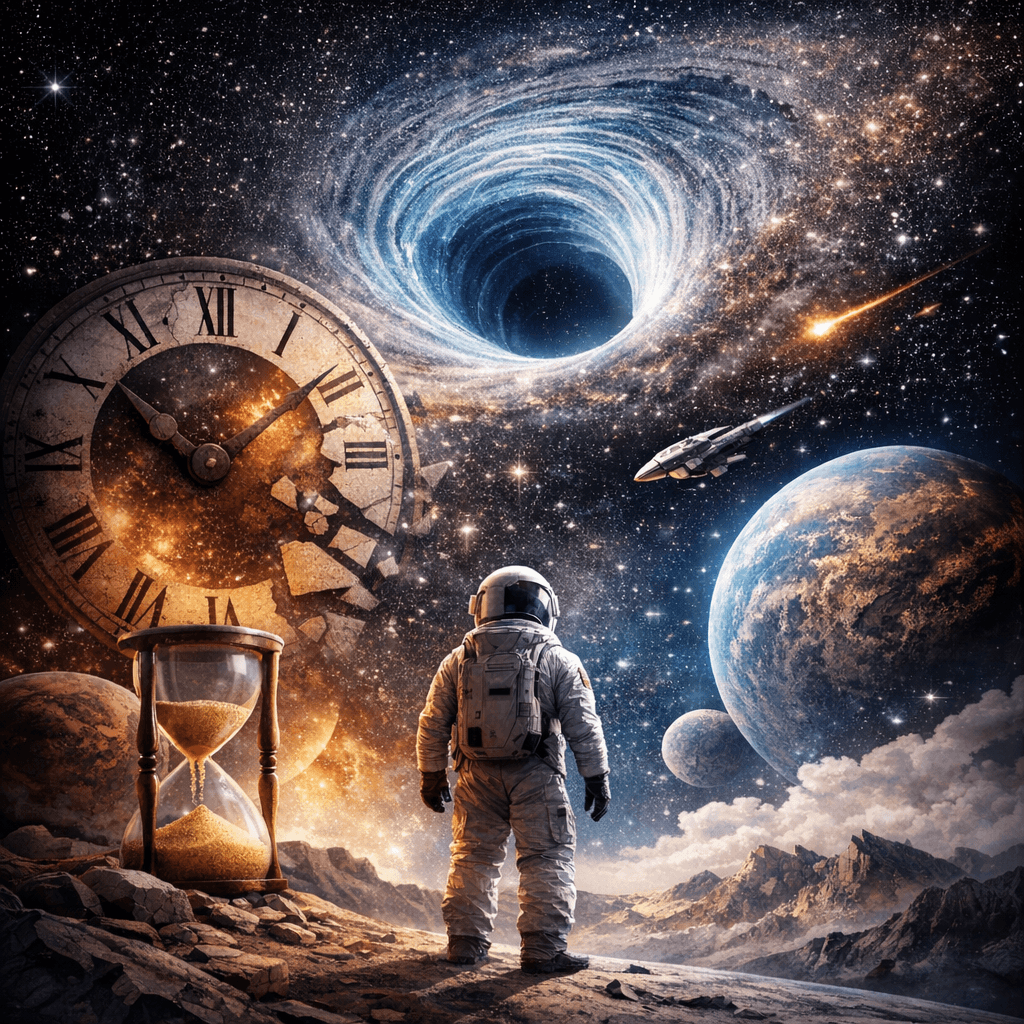 Human standing at the edge of space, symbolizing survival beyond Earth’s time
Time, as experienced on Earth, is not merely a sequence of seconds measured by clocks. It is a biological rhythm, a gravitational condition, and an environmental agreement between life and its planet. Human aging, memory, metabolism, and even perception are synchronized with Earth’s cycles. But as humanity increasingly looks beyond its home planet, a deeper question emerges: can humans survive beyond Earth’s time framework?
This is not a question of science fiction alone. It sits at the intersection of physics, biology, neuroscience, and philosophy—where certainty fades and probability begins.
Earth Time as a Biological Constraint
From a scientific perspective, time is inseparable from motion, energy, and gravity. Einstein’s theory of relativity demonstrated that time is not universal; it slows down at high velocities and in strong gravitational fields. Astronauts aboard the International Space Station age fractionally slower than humans on Earth. This phenomenon is real, measurable, and experimentally verified.
However, time dilation does not free humans from time—it merely alters its rate. The biological clock continues to function, just under slightly different conditions. Biological time is encoded in cellular division, DNA replication, neural plasticity, and hormonal cycles. Aging is not simply a countdown; it is an interaction between cells and their temporal environment.
“Time is not the rigid prison it once seemed. Human consciousness is the first domain where time loosens its grip.”
Leaving Earth: Leaving Time?
Space travel does not mean escaping time, but it does expose its fragility. Outside Earth’s atmosphere, the human body loses many signals it evolved to rely on:
- Consistent gravity
- Regular day–night cycles
- Stable radiation levels
- Predictable environmental feedback
Studies conducted by NASA show that astronauts experience genetic expression changes, immune system shifts, and altered cognitive perception. These effects do not suggest immortality—but they clearly indicate that biological time is flexible, not absolute.
Beyond Biological Time: What Science Allows—and What It Doesn’t
At present, there is no scientific evidence that humans can fully survive outside time. No technology can halt entropy within living systems. Still, research paths explore how biological time might be slowed or restructured:
- Cellular Longevity Research: Studies on telomeres suggest it may be possible to extend cellular lifespan, but not eliminate biological death.
- Induced Hibernation: Experiments involving metabolic suppression hint at future possibilities for long-duration space travel, reducing biological aging during transit.
- Consciousness Beyond Biology: The idea of transferring consciousness beyond the body remains speculative. Science has not yet defined consciousness in measurable terms.
Time as Perception, Not Just Physics
What science often overlooks is that humans do not experience time directly. We experience perceived time. In deep states of concentration or meditation, time awareness can nearly vanish. Brain imaging studies link this to changes in neural networks. This does not represent an exit from time—but it demonstrates that time is partly constructed by the mind.
Is Survival Only Physical?
Perhaps the question itself is incomplete. Survival is often equated with bodily continuation—but that may be a limited definition. Physics tells us that matter transforms rather than disappears.
- Scientifically: There is no evidence that awareness continues after brain activity ceases.
- Philosophically: The question remains open, suspended between materialism and mystery.
Conclusion
As of now, science cannot confirm that humans can survive beyond Earth’s time. What we have are indicators, hypotheses, and partial insights. Yet one thing is clear: leaving Earth may not free us from time, but it forces us to confront its nature.
Survival beyond time may not be an escape from it—but a deeper comprehension of its meaning.
Writing & Reflection: Jassim Al-Saffar
Digital Identity: Ja16im
A meditative artist and philosophical writer exploring the symbolism of perception and meaning through digital art, bilingual books, and reflective scientific essays.
- Limits of Human Cognition: Why Truth May Be Beyond the Mind
- Limits of Human Cognition: Cognitive Closure and Hidden Reality
- The Event Horizon of the Mind: What the Brain Cannot Imagine
- Beyond Earth: Can Humanity Become an Interstellar Species?
- The Final Sunset: What Happens to Humanity When the Sun Dies?
