
Limits of Human Cognition: Why Some Truths May Be Beyond the Human Mind
An Inquiry into the Structural Boundaries of Thought
Imagine a deep-sea creature that has spent its entire existence in the crushing darkness of the Mariana Trench. Because there is no light to see, it has no eyes. Instead, it perceives its world through pressure, temperature, and chemical trails. Now, imagine trying to explain to this creature the concept of “fire,” the movement of “clouds,” or the ethereal nature of the color “blue.” It is not merely that the creature is ignorant of these things; rather, it lacks the biological hardware to even conceive of them. To the creature, the ocean is not a part of the world; it is the entire universe.
Consequently, we must turn this mirror upon ourselves. Are there limits of human cognition that no amount of intelligence, technology, or time can overcome? While we humans pride ourselves on being the “apex knowers” of the cosmos, we often overlook our own biological constraints. We assume that given enough time and data, every locked door in the universe will eventually yield to the key of our intellect. The brain is frequently treated as a universal Turing machine, capable of running any program and understanding any reality. However, this is an assumption born of arrogance, not evidence.
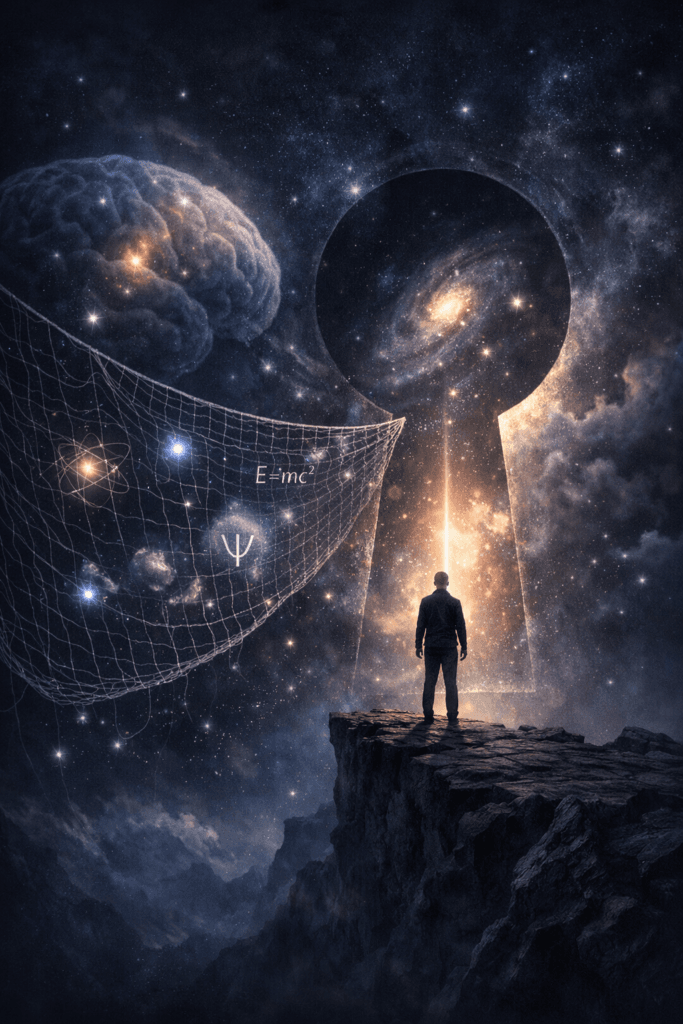
“Are we the fishermen, or are we the net? If we are the net, we must accept that there are things in the ocean of reality that are simply too small to be caught, or too fluid to be held.”
This essay explores a terrifying yet liberating possibility: that what we call “reality” is merely a thin slice of a much larger pie. We will distinguish between ignorance (a temporary lack of information) and cognitive closure (a permanent structural inability to understand). We stand before the keyhole of the universe, peering in, but we must ask: Is the room on the other side simply dark, or are we blind to the light that fills it?
✦ ✦ ✦
The Evolutionary Argument: Survival vs. Truth
To understand the limits of the mind, we must first understand its architect: Evolution. For billions of years, natural selection has shaped the nervous systems of living things with a singular, ruthless criterion: fitness. In this context, it is vital to realize that evolution does not care about truth. Instead, it cares primarily about reproduction and survival. As a result, the mind is a survival tool, not a truth-finding mission.
Furthermore, the brain is an expensive organ to run, consuming roughly 20% of our metabolic energy. Therefore, it is optimized for efficiency, not for comprehensive reality-rendering. Every sensory input is filtered through the lens of utility. If a specific piece of information does not help us find food, avoid predators, or secure a mate, evolution simply discards it. Consequently, our perception is not a window; it is a fortress that protects us from the overwhelming complexity of the actual world.
The Cost of Veridical Perception
Consider the theoretical cost of “veridical perception”—seeing reality exactly as it is. Imagine an organism that perceives every quantum fluctuation, every hidden dimension, and every molecular shift. The processing power required to interpret this “raw data” would be astronomical. While this organism is busy admiring the 11-dimensional beauty of a rock, a predator (which sees a simple, low-resolution version of the world) eats it. Therefore, the organism that sees the truth goes extinct, while the organism that sees a hack survives.
Because we are the descendants of those who saw the hacks, our cognitive faculties are essentially heuristic shortcuts. We perceive solid objects, continuous time, and three-dimensional space not because they are the fundamental building blocks of the universe, but because they are the most efficient “user interface” for a primate. This realization is sobering because it implies that our deeply held intuitions might not be objective truths. They are merely species-specific delusions that help us pass on our genes.
Cognitive Closure: The Locked Room of the Mind
The philosopher Colin McGinn is the primary proponent of “Cognitive Closure.” His argument is deceptively simple but devastating. He asks us to look at the animal kingdom to find a parallel. Consider a chimpanzee. It is intelligent, social, and capable of using tools. However, no matter how much you train a chimpanzee, it will never understand quantum mechanics or calculus. These concepts are “cognitively closed” to it. The chimp’s brain simply does not have the combinatorial capacity to form these concepts.
McGinn’s central question is powerful: If every other species on Earth has a cognitive ceiling, why do we assume humans do not? Is it not more likely that we, too, have a ceiling? We might be surrounded by natural phenomena right in front of our noses that we are biologically incapable of conceptualizing. For instance, just as the concept of a “mortgage” is a mystery to a dog—even though the dog lives in the house—the true mechanisms of the universe might be right here, yet totally invisible to our intellect.
The Problem of Consciousness
Furthermore, McGinn uses this theory to address the “Hard Problem of Consciousness.” He suggests that the answer to how physical meat (the brain) gives rise to subjective experience (the mind) exists as a simple natural property. However, we cannot grasp it because we are trying to use the brain to understand the brain. This is like a telescope trying to see its own lenses. We may be cognitively closed to the link between mind and matter, trapped forever on one side of the conceptual divide.
✦ ✦ ✦
Perception as a User Interface
Building on these ideas, cognitive scientist Donald Hoffman has proposed the “Interface Theory of Perception.” He uses the computer desktop as a powerful analogy. When you look at your screen, you see a blue, rectangular icon for a file. But is the file inside the computer actually blue? Is it rectangular? Of course not. The icon is a “useful lie” that hides the voltages and binary code. If the computer showed you the actual voltages, you would be unable to function.
Similarly, Hoffman argues that space and time are not the stage on which reality plays out. Instead, they are the “headset” we wear to interact with the game. Objects like tables, chairs, and stars are just icons. This suggests that when we look deeper into matter with microscopes, we aren’t seeing reality behind the interface; we are just zooming in on the pixels. The reality behind the screen is written in a language our brains simply cannot compile.
The Fitness vs. Truth Theorem: In mathematical simulations of evolution, organisms that see the truth are consistently driven to extinction by organisms that see only fitness payoffs. This provides a scientific backbone to the idea that our senses are designed to hide the truth in favor of survival.
The Scientific Case: When Intuition Fails
If this sounds like pure philosophy, we need only look at modern physics. For centuries, Newtonian physics worked because it described the “middle-sized” world our brains evolved to handle. However, when we peered into the subatomic realm, our intuition shattered completely. In Quantum Mechanics, we encounter particles that can be in two places at once (superposition) or affect each other instantly across distances (entanglement).
This behavior is “absurd” to the human mind because it violates every rule of logic we hold dear. As Richard Feynman famously quipped: “I think I can safely say that nobody understands quantum mechanics.” We can perform the mathematics, and we can build microchips with it, but we cannot visualize it. Our brains throw “error messages” because we are trying to run a quantum program on hardware designed for the African savannah. This is the strongest evidence that some truths are mathematically provable but cognitively indigestible.
Language as a Cognitive Barrier
Moreover, we must consider that our thoughts are limited by our language. Our languages are built on the foundation of “Subject-Verb-Object.” This structure forces us to see the world as a collection of separate things doing things to other things. But what if reality is not made of “things”? What if it is a singular, continuous process? Our grammar might be a straightjacket that prevents us from even phrasing the correct questions about the nature of existence.
✦ ✦ ✦
What Lies Beyond the Net?
If we accept our cognitive limitations, a breathtaking landscape of speculation opens up. For instance, String theory suggests the existence of 11 dimensions. We are trapped in 3 spatial dimensions + 1 time dimension. A being in a higher dimension could see our entire timeline—from birth to death—as a single static object. We can write the variable x11 in an equation, but we cannot visualize the direction it points toward. Our “net” is simply the wrong shape to catch such a reality.
Furthermore, consider Dark Matter and Energy. About 95% of the universe is made of substances we cannot see or touch. It is passing through us right now, yet we are blind to it. Could there be complex structures, or even “dark life,” within this sector? We call it “dark” not because it is mysterious in itself, but because our biological sensors are not tuned to its frequency. We are like people trying to listen to a radio without an antenna.
The Silence Between the Notes
We must differentiate between the Inaccessible (things we can’t reach) and the Unknowable (things we can’t conceive). The latter is the true frontier. It is the silence between the notes of our intellectual symphony. In this space, the traditional rules of logic may not apply. The very concept of “existence” might be a human category that does not apply to the ultimate foundation of the cosmos.
Conclusion: The Virtue of Intellectual Humility
In conclusion, recognizing the limits of human cognition should not lead to nihilism. On the contrary, it should lead to a profound sense of awe. When we look up at the night sky, we should realize that we are looking through a keyhole. The beauty we see is real, but it is only a fraction of the total grandeur. There is a majesty to the universe that likely exceeds our capacity to admire it, and that is a beautiful thing.
Perhaps the next step in our journey is not to grow a larger brain, but to accept our place as finite beings interacting with the infinite. Or perhaps, the journey is to merge with Artificial Intelligence—a mind that doesn’t share our biological baggage. Regardless of the future, we must learn to find peace in the mystery. We are the friction between the known and the unknown, and that friction is what we call “Wonder.”
“The universe is not only queerer than we suppose, but queerer than we can suppose.” — J.B.S. Haldane
Ultimately, our mission is not to colonize the entire map of truth, but to be grateful for the small, sunlit clearing where we are permitted to live, love, and wonder. The shadows beyond the clearing are not a threat; they are a reminder that the story of existence is much older, deeper, and more mysterious than we could ever hope to tell.
Ja16im | Digital Identity
Writing & Reflection: Jassim Al-Saffar
A meditative artist and philosophical writer exploring the symbolism of perception and meaning through digital art, bilingual books, and speculative scientific essays. Exploring the intersections of the seen and the unseen.
- Limits of Human Cognition: Why Truth May Be Beyond the Mind
- Limits of Human Cognition: Cognitive Closure and Hidden Reality
- The Event Horizon of the Mind: What the Brain Cannot Imagine
- Beyond Earth: Can Humanity Become an Interstellar Species?
- The Final Sunset: What Happens to Humanity When the Sun Dies?
