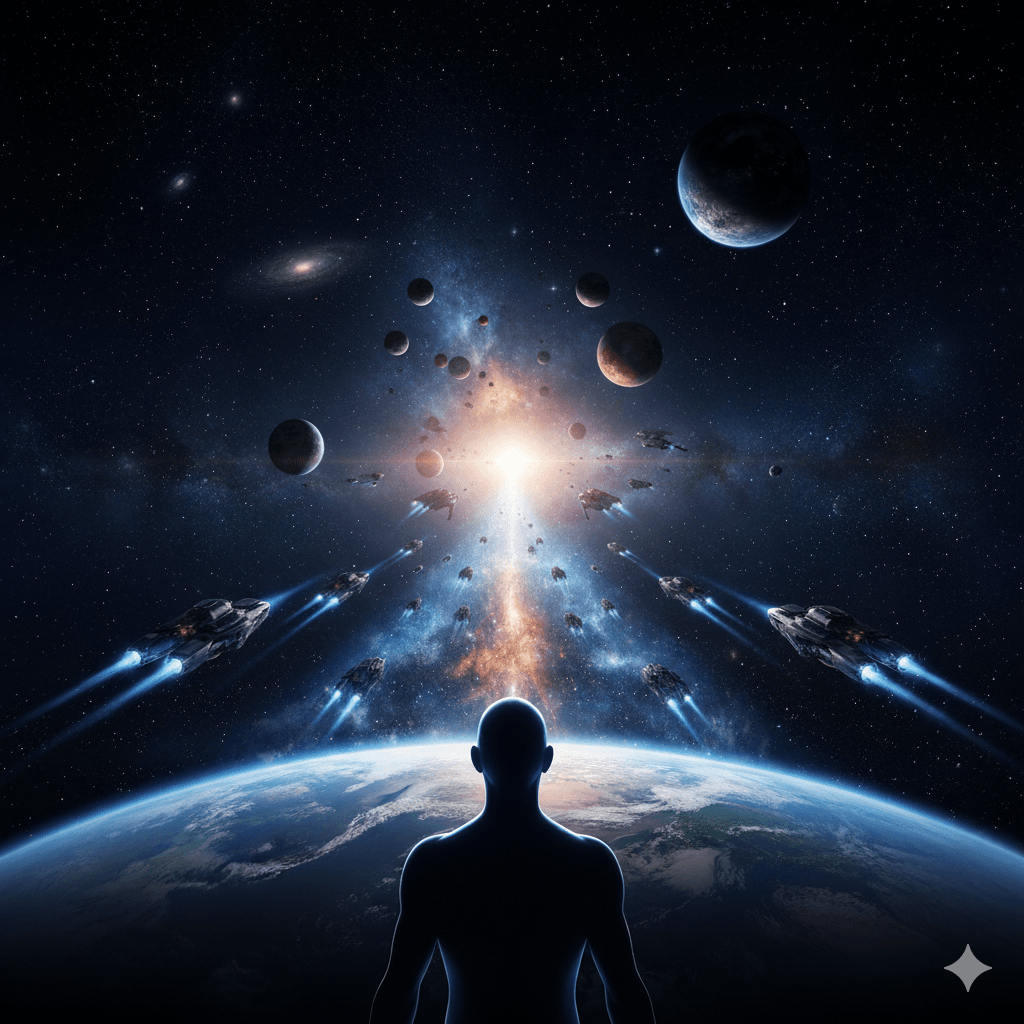
Crossing into the Future: Humanity Between Earth and the Stars
There may come a moment when the future is no longer rooted in Earth, but written in the sky. Space travel is no longer a distant fantasy—it is a scientific possibility, contingent upon one condition: the discovery of Earth-like planets. Worlds that can host life, or at least allow humanity to survive.
1. Human Limits: Time and Distance
Despite our progress, humanity remains bound by natural limits:
- A lifespan brief compared to the age of stars.
- A body fragile against cosmic distances.
- A consciousness still learning to grasp time beyond Earth.
Interplanetary travel is not merely a journey—it is a leap in self-awareness and cosmic understanding.
2. Building in Space: Engineering the Future
In the future, cities may not be confined to Earth. They may rise in orbit, on the Moon’s surface, or beneath the soil of Mars. Massive structures, energy bridges, and pathways connecting Earth to other planets will form the foundation of a new civilizational architecture, where space becomes a natural extension of human presence.
3. Artificial Intelligence: The Mind That Leads
Artificial intelligence will not be a mere tool, but a partner in planning, engineering, and exploration. It will analyze environments, design habitats, and guide missions— becoming the mind that precedes humanity into the unknown, preparing the way toward the stars.
Summary Sentence:
Humanity’s transition into space is not an escape from Earth, but an expansion of life’s meaning, where we become cosmic beings—capable of building, traveling, and contemplating among the galaxies.