
The Future of Humanity: Between Adaptation and Cosmic Passage
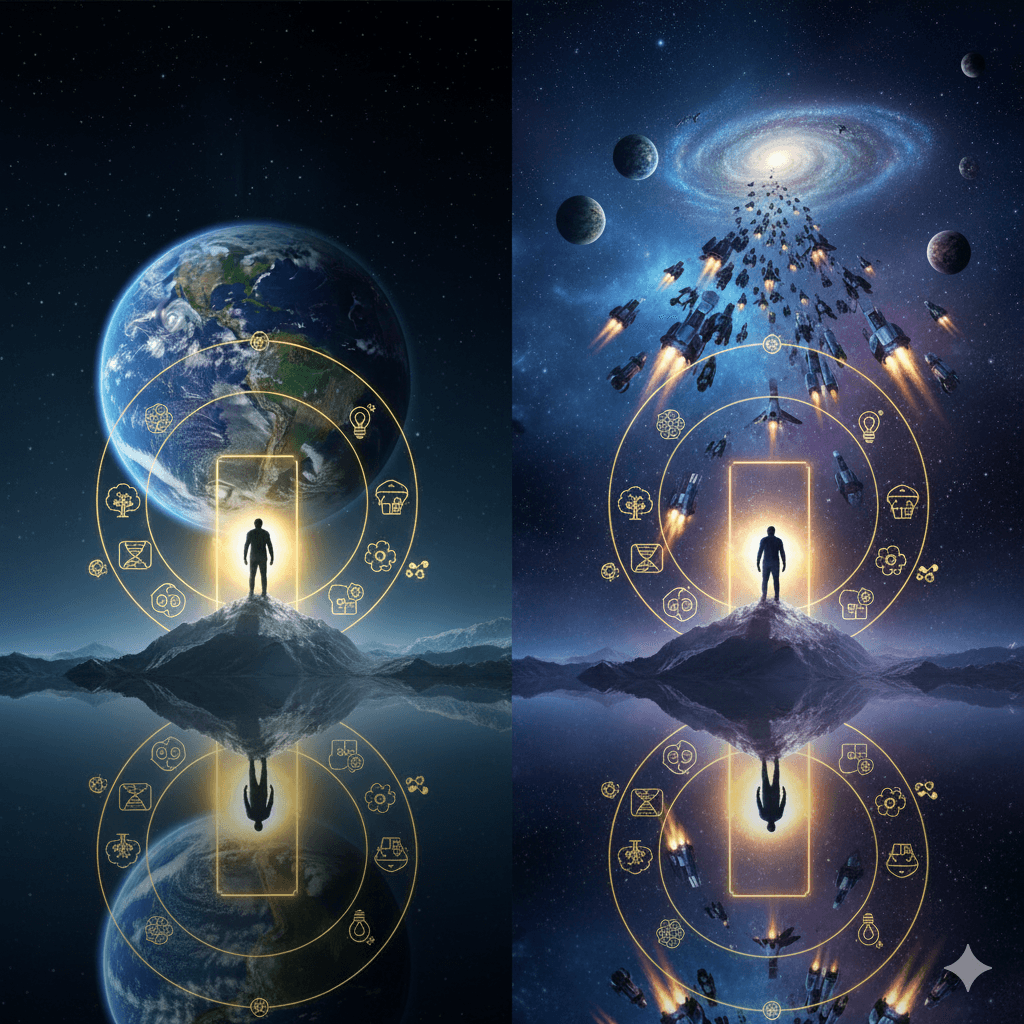
At the heart of this vast universe, humanity stands as a small being— yet within it lies a profound capacity to adapt, and to dream beyond the boundaries of Earth.
1. Adaptation: The Key to Survival
Survival is no longer tied to physical strength, but to intelligence, flexibility, and the ability to adapt. Humans learn to breathe in unfamiliar environments, to read the signals of nature, and to craft tools that shield them from the unknown.
2. Cosmic Migration: A Dream Within Reach
Migrating to other planets is no longer mere science fiction. It is a possibility studied by scientists, imagined by philosophers, and engineered by visionaries.
Such migration may be driven by necessity, by curiosity, or simply by the desire to explore the unknown. But it demands advanced technology, and a patience that transcends time.
3. Technology: The Bridge Between Humanity and the Cosmos
Technology is not just a collection of tools— it is an extension of the human mind, a means to understand the universe, and to engage with it without fear.
Through artificial intelligence, robotics, and synthetic life systems
humanity can build new environments and redefine the meaning of “home.”
4. Time: The Silent Arbiter
Time is invisible, yet it governs all. Ideas may be grand, but their realization requires time, and a gradual evolution of awareness and technology.
Space travel may serve leisure, or scientific pursuit, but only time will decide when it becomes reality.
Summary Sentence:
The future of humanity is not written in ink, but drawn through adaptation, technology, and the courage to dream. In that dream, the cosmos may become a new home.
- Limits of Human Cognition: Why Truth May Be Beyond the Mind
- Limits of Human Cognition: Cognitive Closure and Hidden Reality
- The Event Horizon of the Mind: What the Brain Cannot Imagine
- Beyond Earth: Can Humanity Become an Interstellar Species?
- The Final Sunset: What Happens to Humanity When the Sun Dies?
