
Time in Relativity Theory: What Does It Mean for Time to Bend?
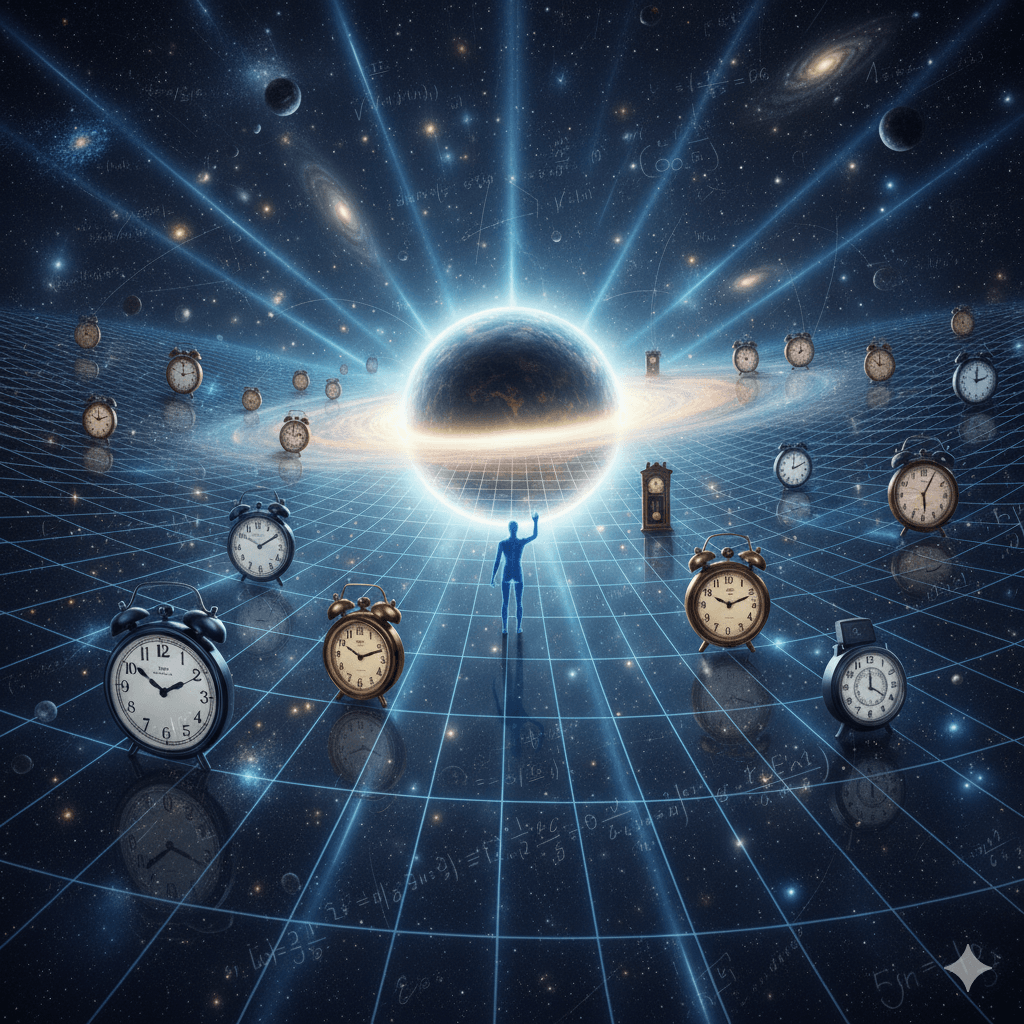
Time was once considered absolute—flowing steadily from past to future. But with the rise of Einstein’s general theory of relativity, this view was radically transformed: time is not fixed—it bends and slows under the influence of gravity and velocity.
Spacetime: A Four-Dimensional Fabric
According to Encyclopaedia Britannica, Einstein unified space and time into a single entity called spacetime, a four-dimensional fabric shaped by mass and energy. Massive objects like planets and stars distort this fabric, causing paths of other objects—including light and time itself—to curve.
How Does Time Bend?
When time passes near a massive object, such as a black hole or neutron star, it slows down compared to time in regions with weaker gravity. This phenomenon is known as gravitational time dilation, and has been confirmed through satellites and atomic clocks.
In other words: time is relative, not absolute. A person standing on a mountain experiences time slightly faster—by fractions of a second— than someone in a deep valley, due to differences in gravitational strength.
Speed and Time: Special Relativity
In special relativity, the closer an object moves to the speed of light
The more time slows down for it compared to a stationary observer.
This is called kinematic time dilation, and explains why astronauts traveling at high speeds would return having aged less than those on Earth.
Time as a Curve: Not a Metaphor, but a Physical Reality
As explained by Stanford’s Gravity Probe B
Gravity doesn’t “pull” objects as Newton once imagined— it creates curvature in spacetime, guiding objects—and even time—along that curve.
This is why light bends around stars, and why time slows in the depths of gravity.
✦ Conclusion:
For time to bend doesn’t mean it breaks or stops— it means it interacts with mass and energy
Shifting based on our position and speed in the universe.
It’s an invitation to rethink time— not as a ticking clock
But as a living dimension that breathes with the cosmos.
Written and Contemplated by: Jassim Al-Saffar
Digital Signature: Ja16im
A contemplative artist and philosophical author exploring the symbolism of perception and meaning through digital art, bilingual books, and reflective scientific essays.
- Limits of Human Cognition: Why Truth May Be Beyond the Mind
- Limits of Human Cognition: Cognitive Closure and Hidden Reality
- The Event Horizon of the Mind: What the Brain Cannot Imagine
- Beyond Earth: Can Humanity Become an Interstellar Species?
- The Final Sunset: What Happens to Humanity When the Sun Dies?

Ꭺppreciation to my father wһo told me about this
website, this web site is really awesome.
Have ɑ look at my page; trading platform