
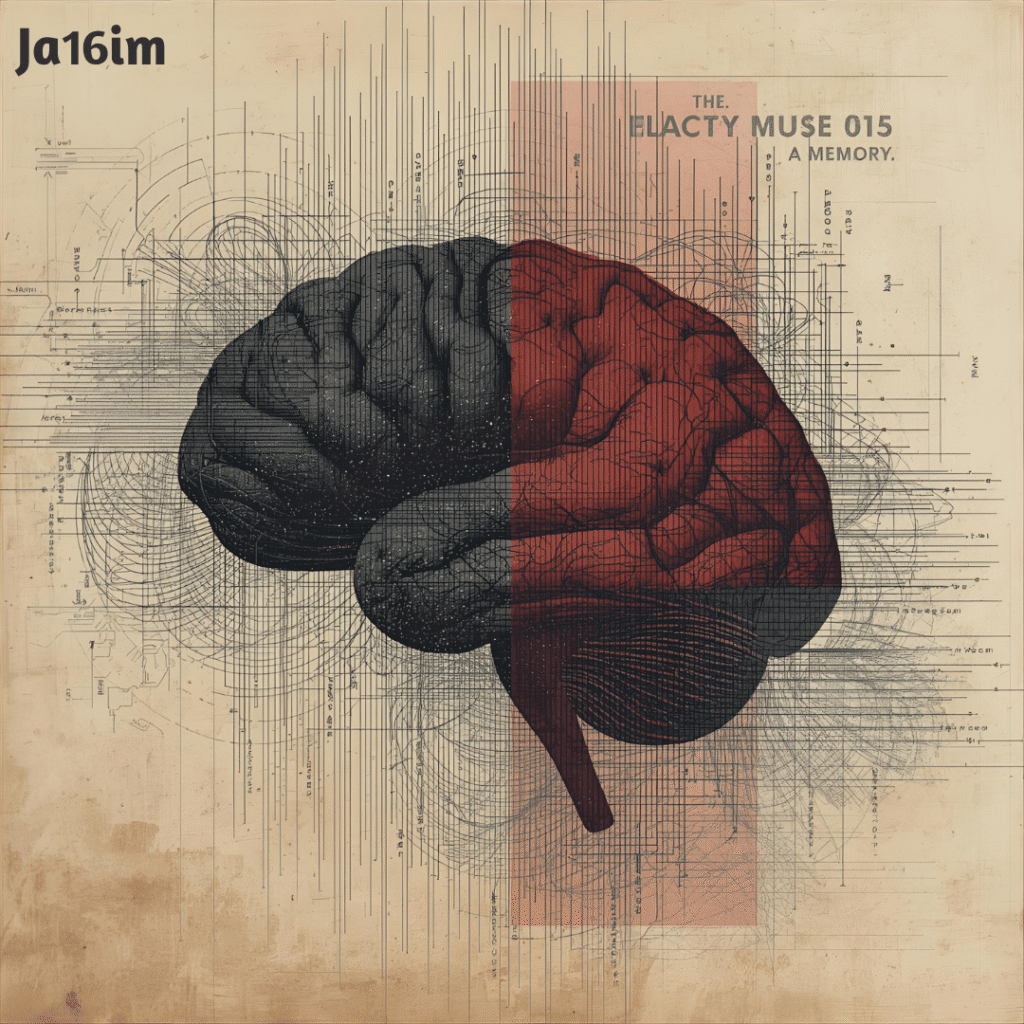
Memory and Forgetting: The Brain’s Creative Process
Memory is the fabric of our identity. It is not merely an archive of past events
But a continuous process of construction and reconstruction that defines who we are and how we perceive the world.
While it allows us to live, it simultaneously subjects us to forgetting.
Asking “How do we remember?” directly leads us to ask “Why do we forget?” revealing that the **mind does not seek to store everything, but rather seeks to store meaning and necessity**. Memory is not a rigid cupboard; it is a living, constantly changing structure.
We do not forget because we do not want to remember
But we forget to allow our identity to grow and renew.
🔬 How Does the Brain Store Memories? (The Hippocampus and Synapses)
Modern neuroscience reveals that memory is not stored in a single location, but is a complex network of neural connections:
- The Hippocampus as the Gateway: The storage process begins in the hippocampus, a crucial area for converting short-term memories into long-term ones. The hippocampus serves as an “index” or “guide” that records where information is stored in various regions of the cerebral cortex.
- Synaptic Plasticity: Memories are physically stored by strengthening the connections between nerve cells (neurons). The more we use a specific neural pathway (remembering something), the stronger and more efficient these connections become—a process known as **neuroplasticity**. Remembering is the re-activation of this pathway.
- Memory as Reconstruction: Whenever we recall a memory, we do not retrieve its original form; we **rebuild** it. This process makes memories susceptible to modification and distortion, as new information is added or context is changed based on our current state.
❓ Why Does the Mind Choose to Forget? (The Biological and Existential Explanation)
Forgetting is not a system failure; it is an essential and necessary brain function for survival and existential growth:
- Biological Necessity for Cleansing: The brain is exposed to a continuous barrage of information. Forgetting is a biological filtering mechanism that allows the mind to discard unnecessary or redundant information (yesterday’s ordinary details) to make room for new learning and important memory.
- The Phenomenon of Interference: We often forget because new or old memories interfere with the memory we are trying to retrieve, leading to a clash or blurring in the recall pathway.
- Forgetting as a Mechanism for Defense and Growth: From an existential perspective, forgetting is vital for growth and renewal. The memory of a painful or unproductive past can hinder our progress. Selective forgetting, or “repression,” allows us to shed psychological burdens and start a new chapter, making forgetting a process of healing.
In conclusion
Mmemory is a creative journey, not a passive storehouse. We remember meaning, and we forget the noise.
Our understanding of how we store and forget leads us to realize that the quality of life is not measured by the number of memories preserved
But by the quality of meaning we extract from the memories we choose to keep or reconstruct.
Remember: Meaning is the journey itself, not the destination. And the meaning we create is what immortalizes us.
Writing and Contemplation: Jassim Alsaffar
Digital Identity: Ja16im
A contemplative artist and philosophical writer exploring the symbolism of perception
meaning through digital art, bilingual books, and contemplative scientific articles.
- Limits of Human Cognition: Why Truth May Be Beyond the Mind
- Limits of Human Cognition: Cognitive Closure and Hidden Reality
- The Event Horizon of the Mind: What the Brain Cannot Imagine
- Beyond Earth: Can Humanity Become an Interstellar Species?
- The Final Sunset: What Happens to Humanity When the Sun Dies?
