
The Self Is a Story: How the Brain Builds Identity
We believe that the “Self” or the “Ego” is a solid, independent entity residing somewhere inside the head, watching, deciding, and holding memory.
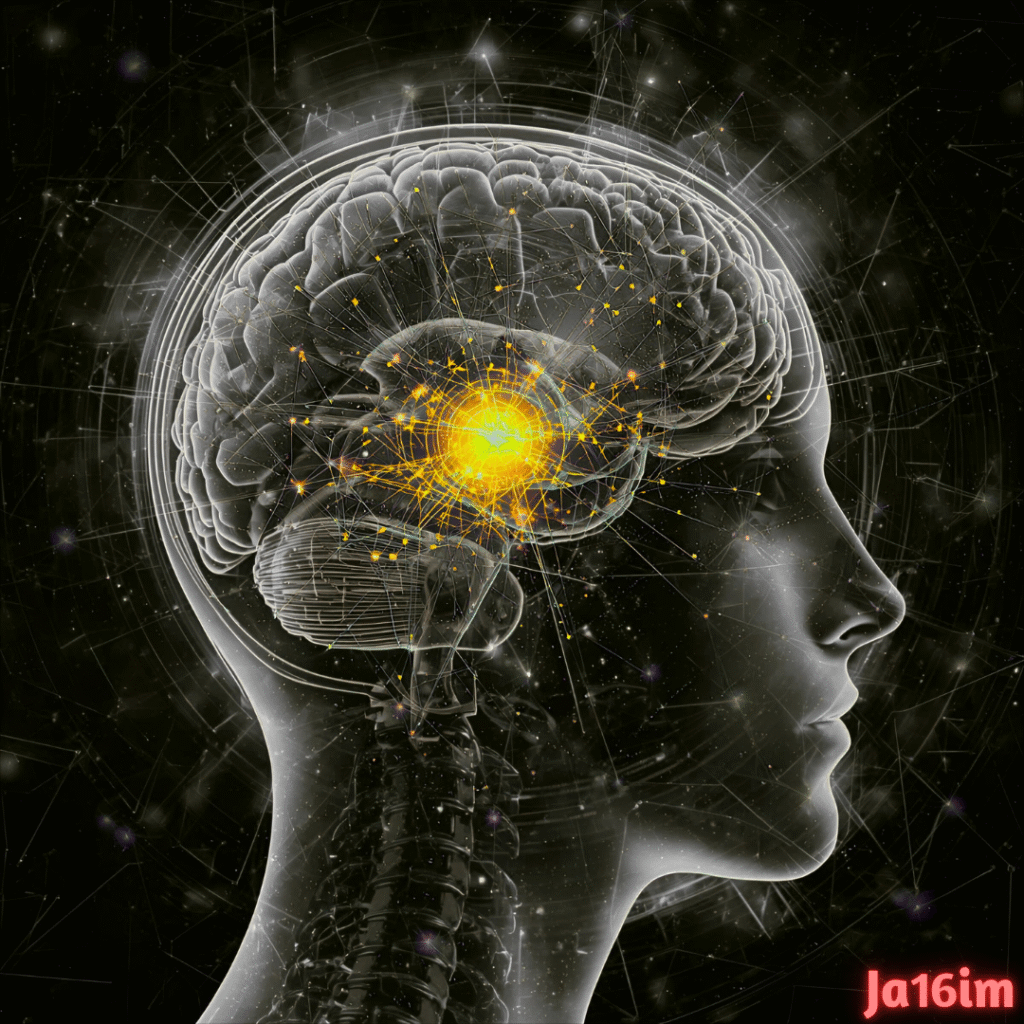
But advances in neuroscience and narrative psychology reveal that the Self is not a single, complete entity; rather, it is a **complex story, a continually updated version, that the mind tells itself for purposes of survival and coherence**.
The inner Self is the best invention the brain could come up with to provide us with a stable reference center in a chaotic world.
The ego is not who we are, but the story we need to be something.
🔬 Science: The Self as a Neural Network and a “Necessary Illusion”
Research confirms that the Self is not stored in one specific brain region (as was once thought). Instead, it is the product of interconnected neural networks:
- The Default Mode Network (DMN): This network plays a pivotal role when we are in a resting state or self-reflection. It is responsible for self-referential thinking and generating internal narratives (I think about myself, I remember what I did). The DMN is the foundation of the “Narrative Self.”
- The Self as a Constructed Story: The inner Self is built by integrating three key components: **Memory** (who I was), **Sensory Perception** (who I am now), and **Prediction** (who I will be). The brain works diligently to link these elements into a single logical chain to create a sense of temporal continuity.
- The Necessary Illusion for Survival: From an evolutionary perspective, the Self is a “necessary illusion.” The feeling of being a separate, controlling “I” is what allows us to regulate behavior, make long-term decisions, and interact socially successfully (you need an I for me to trust you).
✨ Philosophy: Constructing the “I” Through Choice and Responsibility
Philosophically, the Self is considered a space of freedom and choice, transcending mere neurological functions:
- The Flowing Self: Philosophers, particularly in the Buddhist and contemplative tradition, assert that trying to define the “Ego” is an attempt to grasp something that doesn’t truly exist. The authentic Self is not a name, a body, or a memory, but a **continuous, flowing process of pure perception and momentary awareness**.
- The Self as “What We Choose”: The true inner Self is shaped not by what happened to us (our past), but by how we respond to what happened to us (our choices and moral responsibility). A strong Self is one that commits to acting according to its core values, even if it contradicts its old “story.”
- Liberating the Self from the Story: True power can lie in the ability to detach from the rigidity of the “Narrative Self.” Contemplation and mindfulness aim to silence the inner narrator and access the **”Observing Self,”** a state of pure awareness unattached to personal story or preconceived expectations.
In conclusion
The inner Self is the brain’s greatest creative accomplishment. It is not a fixed reality, but a work of art under construction.
The key to power lies in understanding that we are not the “Ego” we remember
But the “Consciousness” that tells the story.
The more flexible this narrative is and the more consciously we can rewrite it
The closer we become to the true empowered Self.
Remember: Meaning is the journey itself, not the destination. And the meaning we create is what immortalizes us.
Writing and Contemplation: Jassim Alsaffar
Digital Identity: Ja16im
A contemplative artist and philosophical writer exploring the symbolism of perception and meaning through digital art
Bilingual books, and contemplative scientific articles.
- Limits of Human Cognition: Why Truth May Be Beyond the Mind
- Limits of Human Cognition: Cognitive Closure and Hidden Reality
- The Event Horizon of the Mind: What the Brain Cannot Imagine
- Beyond Earth: Can Humanity Become an Interstellar Species?
- The Final Sunset: What Happens to Humanity When the Sun Dies?
