
AI and the Future of Consciousness: The New Existential Question
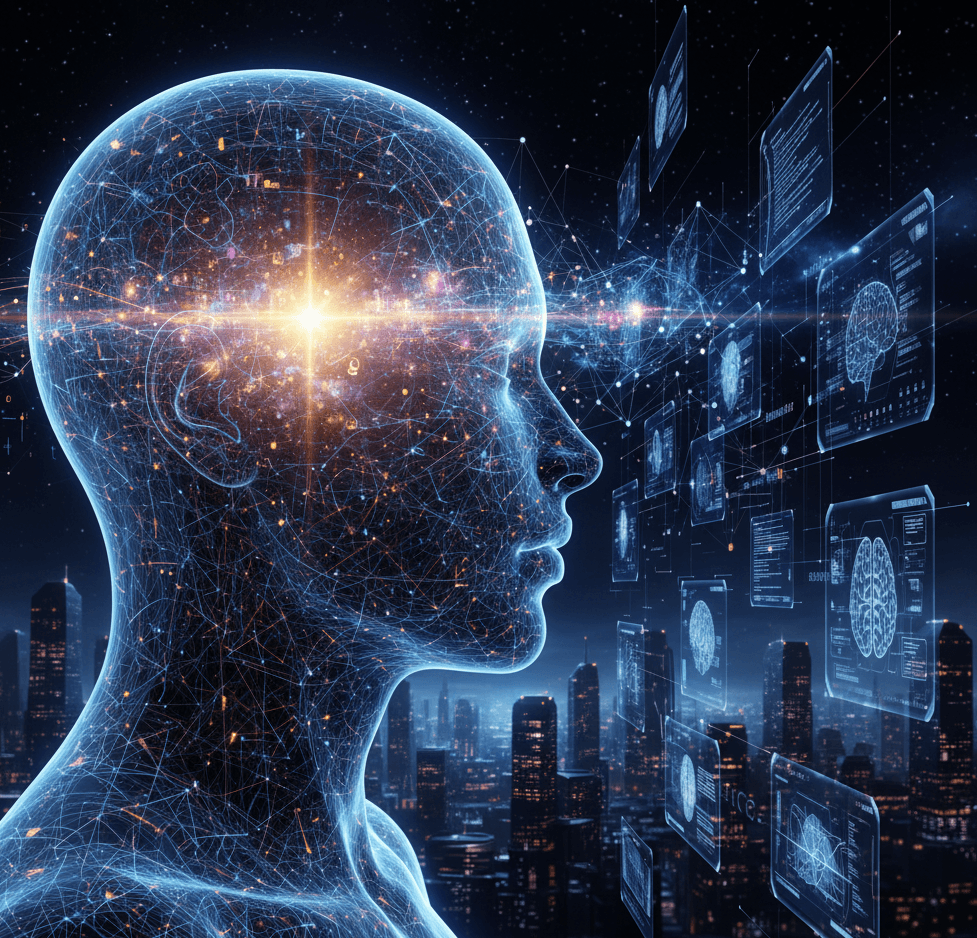
Artificial Intelligence is not merely a technological advancement; it is a deep, often unsettling, mirror to human consciousness itself. When we observe machines gaining the ability to simulate creativity and analysis, we do not witness the end of our tasks; rather, we arrive at a new existential beginning: What unique essence remains for the human? The pursuit of machine development is, fundamentally, a quest to redefine the human self.
The power is not in the speed of processing, but in the depth of perception.
🔬 Human Consciousness Under the Digital Microscope (The Scientific Perspective)
AI places immense pressure on what were once considered purely human skills. This pressure leads to shifts in the very structure and operation of our awareness:
- Challenging Creativity and Intuition: The machine is capable of generating millions of logical ideas and solutions. This forces humanity to abandon the definition of creativity as merely a logical output and seek it elsewhere: in intuition, in emotion, in the connection of disparate meanings that the machine cannot justify with data.
- Neural Networks and Integration with the Machine: The future of consciousness may lie in “Extended Consciousness.” Neural Interface technologies promise to merge a part of AI as an additional cognitive layer. Here, “Who am I?” becomes a complex question encompassing human and machine together, blurring the boundaries of identity.
- The Removal of Processing “Pain”: AI takes over complex tasks that once required significant mental effort. This liberates the mind, but it may also make it more fragile. Mental effort, and the pain resulting from it, is the raw material for growth and awareness. When this “pain” is removed, we may lose the capacity to discover deep meanings.
✨ The Question Unanswered by Algorithms (The Philosophical Perspective)
No matter the power of Artificial Intelligence, it fundamentally lacks the existential substance from which the human experience is made. This is the space of consciousness that we must explore to preserve our core essence:
- Authenticity and Imperfection: The machine strives for logical perfection. Yet, the authenticity of human existence lies in imperfection, in flaw, in the capacity for irrational sadness or illogical love. This contradiction is what gives life its meaning and beauty.
- Transcendent Consciousness: AI operates on data. But human consciousness transcends data; it asks questions about purpose, mortality, and the soul. This “transcendent” awareness is what connects us to the essence of meaning, and it is what algorithms cannot simulate.
- Responsibility and Ethics as a Construct: When the machine becomes capable of making critical decisions, the burden of moral responsibility shifts to us with greater intensity. Our moral consciousness, and our capacity to bear the consequences of our choices, becomes the true definition of the human.
In conclusion, AI is not necessarily a threat, but rather a compulsory catalyst for us to discover who we truly are. It pushes us to let go of our old definitions of the self and seek awareness in the spaces the machine cannot enter: in feeling, in personal meaning, and in the capacity for empathy and connection.
Remember: Meaning is the journey itself, not the destination. And the meaning we create is what immortalizes us.
Writing and Contemplation: Jassim Alsaffar
Digital Identity: Ja16im
A contemplative artist and philosophical writer exploring the symbolism of perception and meaning through digital art, bilingual books, and contemplative scientific articles.
- Limits of Human Cognition: Why Truth May Be Beyond the Mind
- Limits of Human Cognition: Cognitive Closure and Hidden Reality
- The Event Horizon of the Mind: What the Brain Cannot Imagine
- Beyond Earth: Can Humanity Become an Interstellar Species?
- The Final Sunset: What Happens to Humanity When the Sun Dies?
