
Multiverse Theory: Is There Another Earth?
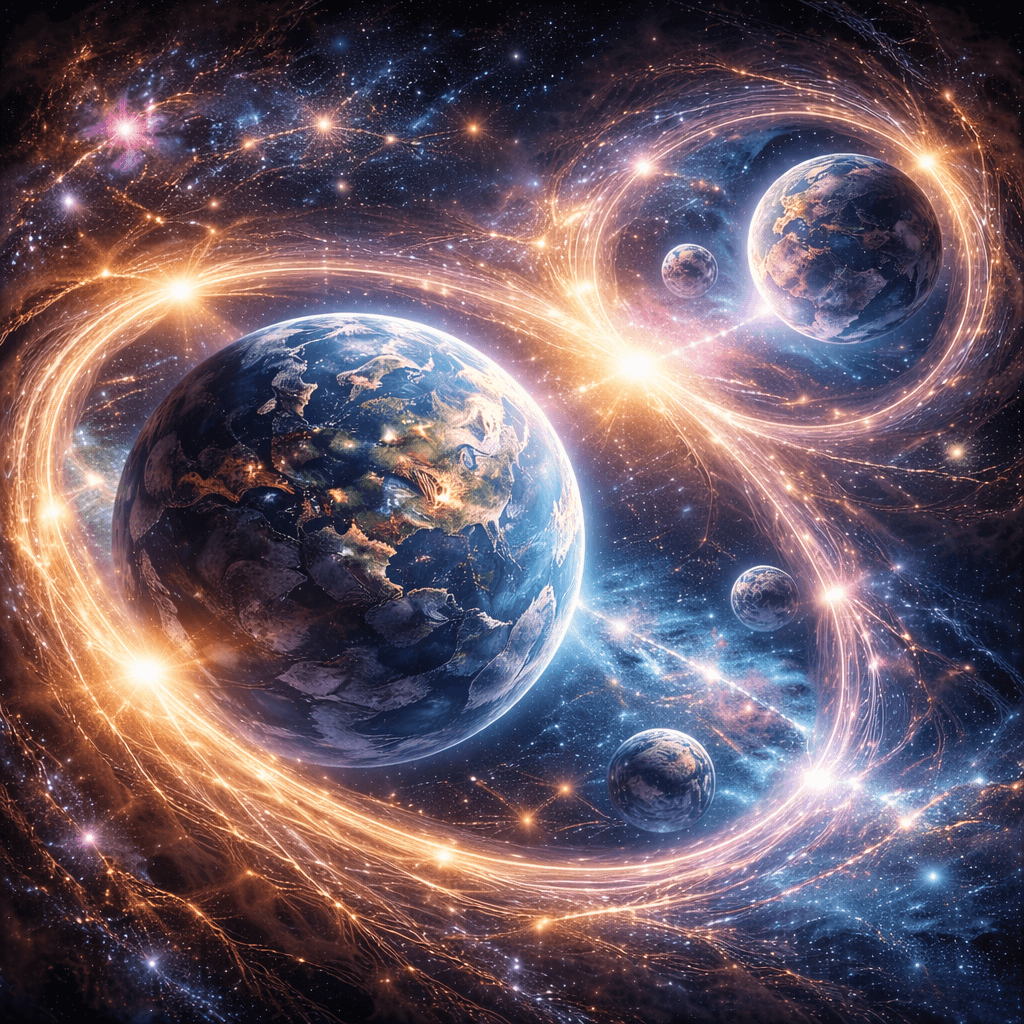 A serene cosmic scene reflecting the idea of multiple Earth-like worlds existing beyond our observable universe.
Across theoretical cosmology, a bold idea continues to surface—the multiverse. If this idea is correct, our universe could be one of many, each with its own physical laws, histories, and structures. This raises a question that lies at the boundary between science and philosophical wonder: Could there be another Earth somewhere beyond our observable universe?
Where Did the Idea of Multiple Universes Come From?
The concept did not originate in science fiction. It emerged from attempts to resolve deep problems in physics. Several frameworks lead to multiverse-like implications:
- Cosmic Inflation: Bubble universes isolated from one another.
- Quantum Mechanics: The branching of every quantum possibility into a separate outcome.
- An Infinite Universe: In an infinite space, statistical repetition of matter (and planets) becomes inevitable.
“None of these ideas have been empirically verified. They remain mathematically plausible hypotheses, not yet observational facts.”
Another Earth: Scientific Possibility or Speculation?
We must distinguish between an Earth-like planet (habitability) and an Earth-like history (a duplicate of our evolution). While astronomy actively finds the first, the second remains in the realm of mathematical probability. Physics does not explicitly forbid a duplicate Earth, but it does not yet provide the evidence for one.
What Would a “Duplicate Earth” Mean for Consciousness?
Even if an Earth-like world existed, this does not imply another you. Consciousness is not merely a product of molecular arrangement; it is a accumulated temporal experience. Without evidence that consciousness is deterministic, the duplicate self remains a philosophical thought experiment.
Why Are Humans Drawn to the Multiverse?
It reduces human centrality and replaces certainty with possibility. At a deeper level, it asks: Could things have been different? The multiverse keeps that question alive.
Conclusion
Science cannot confirm it, nor fully dismiss it. We have models and probabilities that stretch the mind. Perhaps the value of the multiverse lies in its reminder that reality is far larger—and stranger—than our place within it. In that vast uncertainty, the human impulse to imagine remains our greatest tool for understanding.
Written and conceived by: Jassim Alsaffar
Digital Identity: Ja16im
A meditative artist and philosophical writer exploring perception and meaning through digital art and reflective scientific essays.
- Limits of Human Cognition: Why Truth May Be Beyond the Mind
- Limits of Human Cognition: Cognitive Closure and Hidden Reality
- The Event Horizon of the Mind: What the Brain Cannot Imagine
- Beyond Earth: Can Humanity Become an Interstellar Species?
- The Final Sunset: What Happens to Humanity When the Sun Dies?
