
How the Brain Constructs Your “Self”
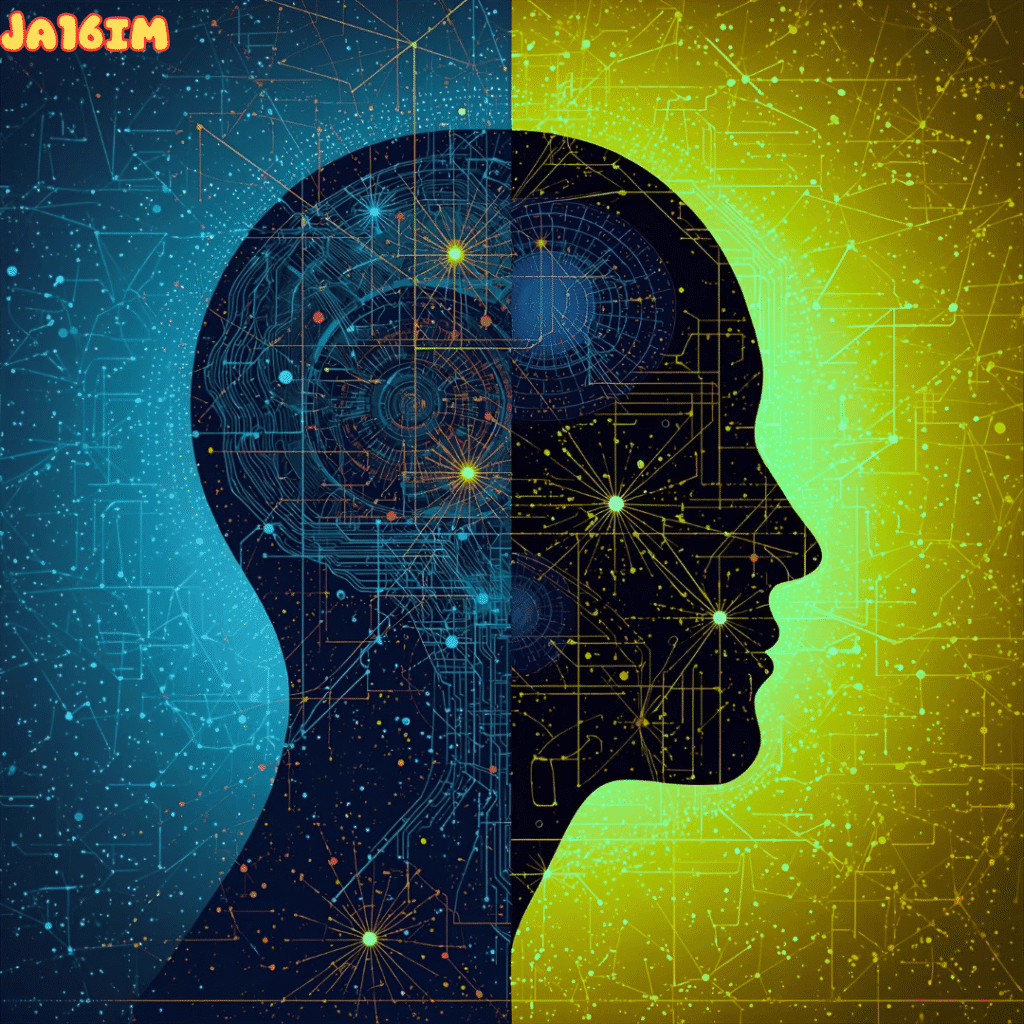
When you look in the mirror, you see a familiar face. When you close your eyes and ask “Who am I?”, a stream of memories and feelings appears, convincing you of a solid, unchanging core. Yet, modern science reveals a startling truth: The person you believe yourself to be is merely a “story” the brain tells itself.
In neuroscience, there is no single center in the brain called “The Self” or “The Soul.” Instead, the brain actively manufactures a “Self-Model”—an edited, revised, and alternate version that often differs significantly from the raw biological reality of your existence. How does this hidden engineering happen?
The person you believe yourself to be is merely a “story” the brain tells itself.
1. The Internal Narrator: The Default Mode Network
Whenever you are not focused on a specific external task, a complex neural web called the Default Mode Network (DMN) lights up. This network is the primary weaver of your life’s narrative.
The DMN’s function is to stitch your past to your imagined future, creating an illusion of “continuity.” It convinces you that the “You” of today is the same entity as the child playing in the schoolyard twenty years ago, even though your cells have regenerated and your mind has fundamentally changed. The brain constructs this coherent version to protect you from fragmentation and to maintain a stable social identity.
2. Memory as an Editing Suite, Not an Archive
We tend to believe our memory is a faithful recording of events. However, science confirms that memory is a process of Reconstruction. Every time you recall the past, your brain rewrites the memory based on your current emotional state and present beliefs.
The brain creates an “alternate version” of your history to fit your current self-image. If you view yourself as strong today, your brain will—subconsciously—edit out old memories of weakness or reframe them as lessons in resilience. You do not remember exactly what happened; you remember the version that serves your survival today.
3. The Illusion of the Pilot
We possess a persistent feeling that there is a “little pilot” sitting behind our eyes, driving the body. In philosophy and psychology, this is known as the “Homunculus Illusion.” Neuroscience suggests no such pilot exists.
Decisions you believe you made consciously are often initiated by neural activity milliseconds before they reach your conscious awareness. Your “Conscious Self” (the alternate version) often arrives late to the scene, merely to claim credit and say, “I decided this.” This illusion of control is biologically necessary for us to feel responsible and learn from errors.
4. Why Build This Version?
If the “Self” is a mental construct rather than a solid fact, why does the brain expend so much energy building it? The answer lies in Social Efficiency and Prediction:
- Simulation: Having a virtual “Self-Model” allows the brain to place “you” in future scenarios (e.g., “What if I move abroad?”) to test outcomes without actual risk.
- Social Interface: To interact with humans, we need to be predictable “characters,” not erratic biological organisms.
Conclusion: Liberation from Rigidity
Realizing that “You” are a continuous construction process rather than a fixed statue offers immense freedom. It means you are not a prisoner of your past nor a victim of your current traits. Since the brain reconstructs the “Self-Model” every day via neural pathways, change is not just possible—it is part of our biological design.
We are not our names or our titles; we are the living, ongoing process attempting to understand existence by building this entity we call “I.”
- Limits of Human Cognition: Why Truth May Be Beyond the Mind
- Limits of Human Cognition: Cognitive Closure and Hidden Reality
- The Event Horizon of the Mind: What the Brain Cannot Imagine
- Beyond Earth: Can Humanity Become an Interstellar Species?
- The Final Sunset: What Happens to Humanity When the Sun Dies?
