
A Mind in a Nutshell: Can We Truly Comprehend Infinity?
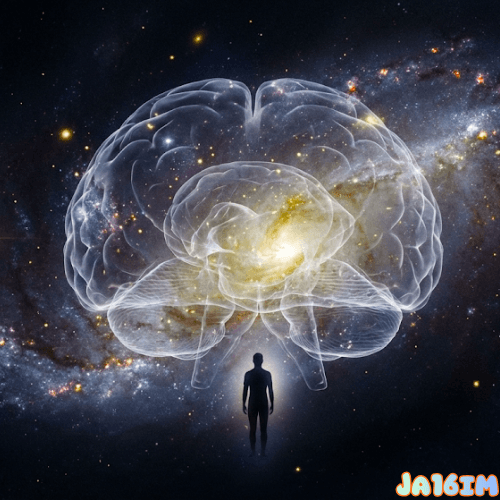
Encased within a skull no thicker than a few millimeters sits a wet, fragile organ weighing merely 1.4 kilograms. This organ—the human brain—attempts a virtually impossible task: to comprehend a universe that spans 93 billion light-years. It is a stark existential paradox; how can the finite possibly encompass the infinite?
When astronomers gaze into the deep field, they do not just see stars; they confront a wall of numbers that defy biological imagination. We live in a state of “Cosmic Vertigo,” where our language and our senses collapse under the sheer scale of reality.
“The universe is not only queerer than we suppose, but queerer than we can suppose.”
— J.B.S. Haldane
The Evolutionary Trap: Why Our Brains Are “Locally Made”
To understand our incapacity, we must return to the beginning. The human brain evolved on the African savannah for a singular purpose: survival. Our cognitive hardware was programmed to handle short distances (Where is the lion? Where is the water?) and small numbers (How many people are in the tribe?).
We are “linear thinkers” living in an exponential universe. We easily grasp the difference between the number 1 and 10. But when faced with exponential growth or cosmic distances, our intuition fails. We understand “billion” as a mathematical symbol, but we do not feel its magnitude.
The Illusion of Scale: The Sand and the Ocean
Because we cannot visualize the numbers, we resort to metaphors. We say, “If the Sun were a grain of sand, the nearest star would be 7 kilometers away.” These analogies are useful, but they are also deceptive. They shrink the universe to fit our kitchen tables, giving us a false sense of control and comprehension.
In reality, the observable universe contains roughly 2 trillion galaxies. Each galaxy houses hundreds of billions of stars. Merely attempting to visualize the void between two galaxies is enough to induce cognitive paralysis. We do not see the universe as it is; we see a “scale model” constructed by our minds so that we can sleep at night without being crushed by insignificance.
Mathematics: The Sixth Sense
If our biological senses are inadequate, how have we managed to measure the cosmos? The answer lies in Mathematics. Math is the sixth sense humanity developed to “touch” the untouchable.
We do not need to “visualize” the eleven dimensions of string theory, nor do we need to “feel” the curvature of spacetime around a black hole. We write the equations, and the symbols do the heavy lifting for us. Mathematics allows us to bypass our biological limitations, enabling us to navigate infinity while sitting at our desks.
Beyond the Horizon: The Invisible Universe
Even more terrifying than the size of the universe we can see, is the size of the universe we cannot. We are trapped inside a “bubble” called the Observable Universe. The boundaries of this bubble are defined by the time it has taken light to reach us since the Big Bang.
According to cosmic inflation theory, the actual universe may be millions of times larger than the part we see—or perhaps truly infinite. Infinity is the concept where the human mind surrenders. In an infinite universe, everything that can happen, will happen, and will happen an infinite number of times.
“We are like an ant standing on the shore of the ocean, trying to understand the depth of the water and the movement of the tides using only our limited antennae.”
Conclusion: The Humility of Knowledge
Is the human mind capable of understanding the size of the universe? The short answer is: No, not viscerally. We are not biologically equipped to hold such grandeur.
However, the beautiful answer is that we try anyway. Our greatness lies not in encompassing the cosmos, but in our audacity to point our telescopes and equations into the dark, attempting to map the unknown. We may be mere “stardust” that has become self-aware, but we are stardust with the curiosity to challenge infinity.
- Limits of Human Cognition: Why Truth May Be Beyond the Mind
- Limits of Human Cognition: Cognitive Closure and Hidden Reality
- The Event Horizon of the Mind: What the Brain Cannot Imagine
- Beyond Earth: Can Humanity Become an Interstellar Species?
- The Final Sunset: What Happens to Humanity When the Sun Dies?
