
The Event Horizon of the Mind: What the Brain Cannot Imagine
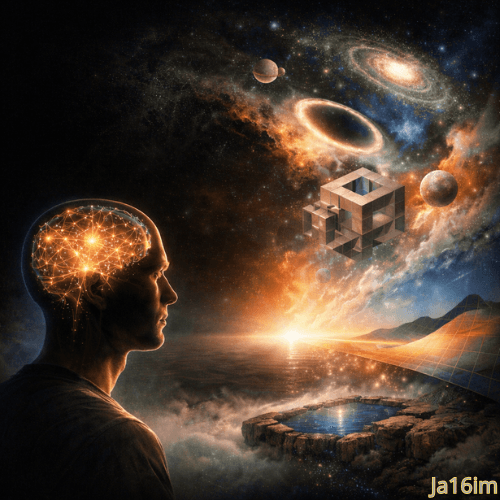
A Journey to the Edge of Reason.. Where Imagery Fails and the Void Begins
We often pride ourselves on the human brain’s ability to pierce the veil of the unknown—from the complexities of quantum mechanics to the secrets of distant galaxies. But have you ever stopped to consider that this miraculous organ is, ultimately, a “biological product” evolved for specific survival functions?
There are realms of existence where the mind knocks, but the door remains barred. Not because they are mathematically complex, but because our neurological “hardware” was never designed to render them. We are prisoners of a “cognitive bubble” that protects us from madness while simultaneously blinding us to absolute reality.
“We are attempting to map the ocean with a teaspoon. The inability to imagine is not a lack of intelligence, but the natural boundary of a system designed to understand ‘survival,’ not ‘infinity’.”
The First Dilemma: Absolute Nothingness
Try to imagine “Nothingness.” You will find that your brain fails instantly. It will either conjure a black void, an empty space, or a profound silence. But black is a color, space is a dimension, and silence is merely the absence of sound.
Absolute Nothingness is the absence of time, space, matter, and consciousness itself. The brain, functioning as a processor of “things,” is structurally incapable of processing “no-thing.” Imagining the void is like trying to play a video file on a device without a screen; the data may exist, but the visual representation is impossible.
The Second Dilemma: Higher Dimensions
We are three-dimensional beings (length, width, height). Physics tells us of dimensions that may reach up to 11 in String Theory. We can write the mathematical equations for these dimensions with staggering precision, yet we are utterly unable to “see” them in our mind’s eye.
Imagine trying to explain “depth” to a being living on a flat piece of paper (2D); they would never grasp it. Likewise, the human brain remains unable to form a mental image of a fourth spatial dimension because our evolution never required us to leap beyond our 3D constraints.
Colin McGinn’s Paradox: Philosopher McGinn suggests that the human mind suffers from “Cognitive Closure.” Just as a cat will never understand the concept of democracy no matter how its intelligence evolves, we possess biological limits that prevent us from fully comprehending the nature of consciousness or the origin of matter.
✦ ✦ ✦
Beyond Time and Space
How did time begin? And what was before it? The brain falls into a trap of infinite regression when posing these questions. We are hardwired for “Causality”—cause and effect. The idea of a permanent “Now,” or an existence without a cause, is a forbidden zone for the human imagination, even though it may be the very essence of cosmic truth.
Conclusion: Humility in the Face of Mystery
Acknowledging the limits of our minds is not a surrender; it is the highest form of knowledge. The inability to imagine is what makes the universe a place of eternal enchantment and wonder. We live in a small oasis of light, surrounded by an ocean of mystery that our eyes may never see, but our souls can feel. Perhaps the true beauty of the cosmos lies in those parts that refuse to be imprisoned within the frame of our human imagination.
Digital Identity: Ja16im
- Limits of Human Cognition: Why Truth May Be Beyond the Mind
- Limits of Human Cognition: Cognitive Closure and Hidden Reality
- The Event Horizon of the Mind: What the Brain Cannot Imagine
- Beyond Earth: Can Humanity Become an Interstellar Species?
- The Final Sunset: What Happens to Humanity When the Sun Dies?
