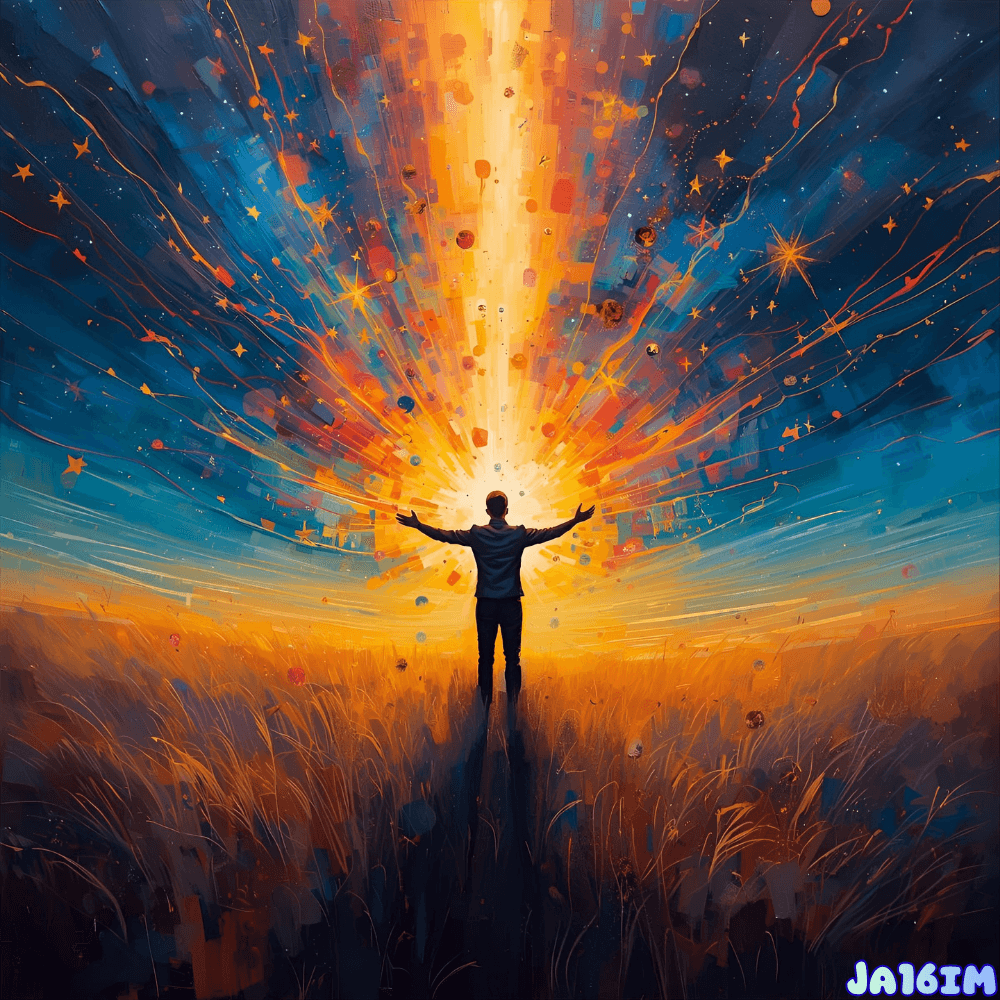
The Rhythm of the Universe in Your Veins: How Do Planets Set Your Biological Clock?
In the noise of modern life, under bright neon lights and in our air-conditioned rooms, we have forgotten a simple primal truth: Humans are **Rhythmic Beings**. We evolved over millions of years not in isolation from the universe, but as a direct response to it. Every cell in your body possesses a small “clock.” Moreover, this clock is not set to Greenwich Mean Time, but to the timing of the stars, the sun, and the Earth’s magnetic field.
The science of **Chronobiology** reveals today that our relationship with the cosmos is not merely poetic contemplation. Rather, it involves precise chemical and electromagnetic bonds that govern our health, our mood, and even our consciousness.
1. The Dance of the Sun: Your Daily Rhythm (Circadian Rhythm)
The most powerful cosmic influence on you is the star you orbit: The Sun. Light is not just a means of vision; it is “information.” When morning light hits your retina, it sends an immediate signal to a brain region called the **Suprachiasmatic Nucleus (SCN)**. This is the “Maestro” leading your biological orchestra.
- At Sunrise: The brain commands the release of Cortisol (the wakefulness hormone) to start movement.
- At Sunset: When the light turns red and fades, the brain releases Melatonin (the sleep and repair hormone).
2. The Pulse of the Earth: Schumann Resonance
Did you know the Earth has a heartbeat? In the space between the Earth’s surface and the ionosphere, lightning strikes constantly around the globe. This creates electromagnetic waves with a base frequency of **7.83 Hz**. This is called the **Schumann Resonance**.
The astonishing surprise is that this frequency (7.83 Hz) perfectly matches the frequency of “Alpha” and “Theta” waves in the human brain. These are the waves responsible for relaxation, creativity, and healing. Our brains have evolved to be in “resonance” with the planet. When you feel psychological relief walking barefoot on soil or sitting in nature, it is not imagination. It is a process of **Synchronization** that re-tunes your brain frequency to match the Earth’s frequency, thereby reducing inflammation and stress.
3. Lunar Gravity: Water and Blood
If the moon can pull billions of tons of ocean water in tides, is it plausible that it doesn’t affect the human body, which is 70% water?
Modern studies are beginning to validate ancient knowledge. Sleep research (published in the journal *Science Advances*) found that humans sleep less and have lighter sleep on nights leading up to a full moon, even in completely dark rooms.
The word “Lunatic” is derived from “Luna” (Moon). Ancients noticed that emotions flare up with the full moon. It might not be magic. Instead, it could be a slight change in gravity and the electromagnetic field affecting body fluids and the nervous system. This makes us more sensitive and emotionally transparent on those days.
4. Solar Storms: Does the Sun Affect Our Nerves?
**Heliobiology** is an emerging scientific field studying the effect of solar activity on life. The sun is not a static lamp. It is a raging ball releasing solar winds and magnetic storms. When a solar storm hits Earth’s magnetic field, it doesn’t just disrupt GPS devices. It also disrupts the human nervous system.
Scientists have found a link between geomagnetic storms and changes in **Heart Rate Variability (HRV)**, as well as increased rates of anxiety in humans. We are magnetically sensitive. Therefore, any disturbance in the “Macro Field” (Sun and Earth) is immediately reflected in the “Micro Field” (your heart and brain).
5. The Philosophical Summary: Returning to “Harmony”
What does all this mean? It means that modern mental and physical illness might be, at its core, a disease of **”Rhythmic Separation”** (Arrhythmia). We try to live in a linear, fast, and mechanical rhythm. Meanwhile, the universe operates in a circular, calm, and undulating rhythm.
The solution does not always lie in medication. Sometimes, it lies in **”Re-tuning.”**
- See the sunlight in the morning.
- Touch the earth with your feet.
- Respect the darkness of the night.
- Realize that your mood swings might be an echo of the sky’s fluctuations.