
Earth as a Living Being: Does the Planet Possess a “Global Consciousness”?
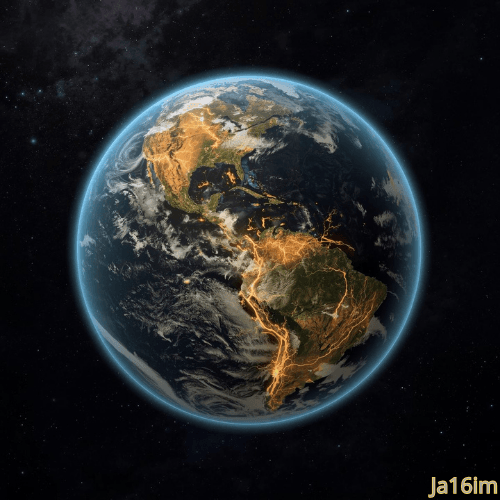
Between Planetary Biology and Modern Gaia Theory
We have long viewed Earth as a solid platform, merely a “stage” upon which the drama of life unfolds. Inert rocks, saline oceans, and a neutral atmosphere. But what if the stage itself is the main actor? What if Earth is not just a place that contains life, but is “Life” itself, in its most magnificent and colossal manifestation?
This is not mere fantasy; it is the essence of the Gaia Hypothesis, which proposes that Earth functions as a single, self-regulating system that maintains conditions for life. But modern science is beginning to take it a step further: Does this system possess a form of “consciousness”?
“Earth doesn’t have an atmosphere; it is the atmosphere. It doesn’t contain oceans; it is the oceans. We are not inhabitants upon it, but cells within its vast body.”
The Superorganism: How Does Earth Speak?
In biology, we define a living organism by its ability to maintain “homeostasis”—a stable internal equilibrium despite changing external conditions. Earth has done this with astonishing brilliance for billions of years. The planet’s temperature, atmospheric oxygen levels, and ocean salinity have all remained within precise limits, allowing life to flourish, despite countless catastrophes and asteroid impacts.
This meticulous regulation closely resembles the functions of the nervous and endocrine systems in the human body. Forests act as lungs, oceans as a heart pumping thermal currents, and soil as intestines breaking down and recycling matter. This organic interconnectedness suggests that Earth “perceives” its state and responds to changes.
Planetary Consciousness: Does Earth Think?
When we speak of “planetary consciousness,” we are not referring to human-like awareness with language or an ego. Instead, we speak of a “collective consciousness” or “systemic intelligence.” Just as a single neuron in your brain does not grasp the concept of “consciousness,” but the interaction of billions of neurons produces your mind, so too might the interaction of billions of living organisms with the atmosphere and hydrosphere produce a form of “planetary perception.”
Recent studies on fungal networks in forests (the “Wood Wide Web”) indicate that trees communicate and exchange nutrients and information through a complex underground network. If a forest possesses a neural network, what prevents the planet as a whole from possessing a cosmic consciousness network?
The Modern Gaia Hypothesis: Developed by scientist James Lovelock, it posits that Earth’s biosphere and its physical environment (rocks, water, air) are inextricably linked, forming a complex system that maintains “life” as its ultimate goal, even if it requires sacrificing certain species to save the whole.
✦ ✦ ✦
Humanity: Earth’s “Mind” or “Cancer”?
In this context, our role as humans becomes prominent. From a Gaia theory perspective, we might be the “nervous system” that Earth developed to see itself, and to protect itself from external threats like meteorites. We are the consciousness that can guide the planet toward a better future.
Yet, the paradox lies in our current actions, which often resemble an “autoimmune disease,” where cells begin to attack the very body that contains them. Our detached consciousness, believing itself to be the master of the planet rather than a part of it, is the greatest challenge to Gaia’s continued well-being.
Conclusion: Returning to the First Embrace
Recognizing Earth as a living being transforms our relationship with it from one of “consumption” to one of “belonging.” We do not live “on” Earth; we emerge “from” Earth. Every atom in our bodies is a piece of this magnificent organism.
Perhaps it is time to stop asking ourselves, “How do we save Earth?” and instead ask, “How do we harmonize with Earth’s consciousness?” The planet will continue to maintain its balance with or without us, but our survival depends on our ability to realize that we are merely an inhale and exhale in Gaia’s great breath.
Writing & Reflection: Jassim Al-Saffar
Digital Identity: Ja16im
- Limits of Human Cognition: Why Truth May Be Beyond the Mind
- Limits of Human Cognition: Cognitive Closure and Hidden Reality
- The Event Horizon of the Mind: What the Brain Cannot Imagine
- Beyond Earth: Can Humanity Become an Interstellar Species?
- The Final Sunset: What Happens to Humanity When the Sun Dies?
