
Rewiring the Soul: What Happens to the Human Brain at the First Sight of Space?
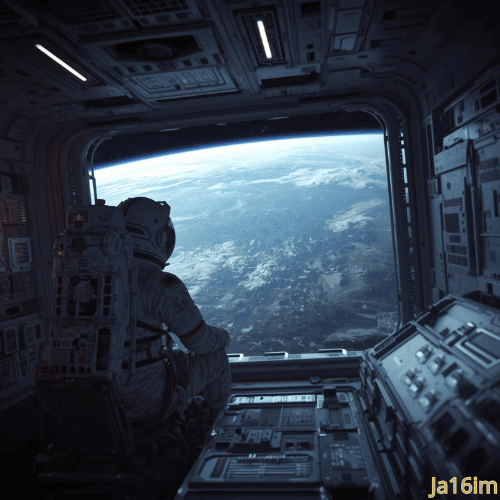
Astronaut Experiences Between Cognitive Shock and Transcendent Ecstasy
Imagine you have spent your entire life inside a sealed room, and suddenly, the wall collapses, revealing the ocean for the first time. This analogy barely scratches the surface of what an astronaut feels in that pivotal moment—when the violent vibrations of launch cease, silence falls, and they look out the small viewport to face “nothingness” head-on.
The human brain, evolved over millions of years to deal with finite horizons and familiar blue skies, faces a massive “cognitive shock” in that instant. It is not merely a new visual experience; it is a moment when the old reality stops working, and the brain must begin rewriting its fundamental concepts of existence.
“I looked down and I saw that blackness, the deepest black you can imagine. It was death itself. Then I turned and saw the Earth… It was life in its purest form. That moment was the most profound spiritual experience I have ever had.”
— William Shatner, after his trip to space at age 90.
The Neuroscience of “Sublime Awe”
Upon seeing space for the first time, the brain enters a state psychologists call “awe,”
But it is awe of an extreme nature. Fear centers (the amygdala) activate due to facing an infinite, hostile void, while simultaneously, pleasure and reward centers light up due to the stunning beauty of Earth.
This conflict creates a state of “transcendent confusion.” The brain possesses no “previous file” to categorize this experience. There are no horizon lines, no “up” or “down,” and the sky is not a ceiling but a bottomless abyss. In this moment, the brain is forced to abandon its old maps of reality and begin constructing an entirely new one—a map where the human is tiny, and the cosmos is vast.
The “Overview Effect”: When Borders Dissolve
The most well-documented phenomenon in astronaut experiences is known as the “Overview Effect.”
It is a sudden, shocking cognitive shift realizing that all the boundaries we have drawn on Earth—political, racial, and religious borders—are merely invisible illusions from space.
Astronauts describe an overwhelming sense of planetary unity. They see the atmosphere as a terrifyingly thin, fragile shell protecting all known life. This direct visual perception reshapes the prefrontal cortex responsible for moral reasoning and abstract concepts. “Home” is no longer your city or nation; the entire blue planet becomes the only “tribe” to which you belong.
Defining the Overview Effect: A cognitive shift in awareness reported by some astronauts during spaceflight. It centers on the experience of seeing Earth directly from space as a tiny
Fragile ball floating in the void, generating a profound sense of human interconnectedness, environmental responsibility, and the triviality of human conflict.
✦ ✦ ✦
Returning with a New Consciousness
No one returns from space the same person they were when they left. The experience leaves an eternal scar on consciousness, but it is a scar made of light.
Astronauts often return more inclined toward philosophical reflection, less interested in the material details of daily life
And more engaged in humanitarian and environmental causes.
A brain that has seen Earth as a “lone blue oasis” in a dark cosmic desert cannot return to viewing things with the same narrowness as before.
It is not just a journey through distance; it is an evolutionary leap in human perception.
Conclusion: The Cosmic Mirror
Looking into space is not looking outward; it is, in truth, a deep look inward. Space is the dark mirror that reflects our reality:
we are transient beings, living aboard a fragile and magnificent biological spaceship.
Perhaps we don’t all need to travel to space to experience this shift. It is enough to close our eyes and imagine that moment
To allow our minds to touch a fraction of that awe, and to realize that we are all astronauts on a shared journey through this great cosmic ocean.
Writing & Reflection: Jassim Al-Saffar
Digital Identity: Ja16im
A meditative artist and philosophical writer exploring the symbolism of perception and meaning through digital art, bilingual books, and speculative scientific essays.
- Limits of Human Cognition: Why Truth May Be Beyond the Mind
- Limits of Human Cognition: Cognitive Closure and Hidden Reality
- The Event Horizon of the Mind: What the Brain Cannot Imagine
- Beyond Earth: Can Humanity Become an Interstellar Species?
- The Final Sunset: What Happens to Humanity When the Sun Dies?
