
Hybrid Intelligence: The Future of the Human Mind
The question of the human mind’s future is fundamentally a question about the endpoint of evolution. Are we still biologically evolving towards physically larger and faster-processing brains? Or has evolution shifted its course, becoming an external, technological process dependent on merging the machine mind with the biological one? The answer lies in deconstructing the concepts of “bigger” and “faster”; the increase in capacity is no longer measured by biological mass, but by **the quality of external connection and the speed of processing meaning.**
A physically larger brain is not necessarily smarter; but a more conscious brain is the most powerful.
🔬 Biological Evolution: The Limits of the Physical Apparatus
Despite the immense leap in human brain size that occurred hundreds of thousands of years ago, recent biological evolution in brain size has slowed considerably. Several constraints limit the future growth of the physical mind:
- Anatomical Constraints: The current size of the brain poses a significant challenge to the birthing process (due to the narrow birth canal in females). Any substantial increase in size would require a radical evolutionary compromise.
- Energy Cost: The brain consumes about 20% of the body’s total energy, despite accounting for only 2% of its weight. A size increase would mean a massive increase in energy consumption, potentially compromising the survival of the organism.
- Increased Complexity, Not Size: Neuroscientists suggest that future evolution may focus on increasing the density and efficiency of neural connections (neural plasticity) rather than increasing the physical dimensions of the brain. This allows for faster processing without physical growth.
🚀 The Technological Leap: The Extended Mind and Hybrid Intelligence
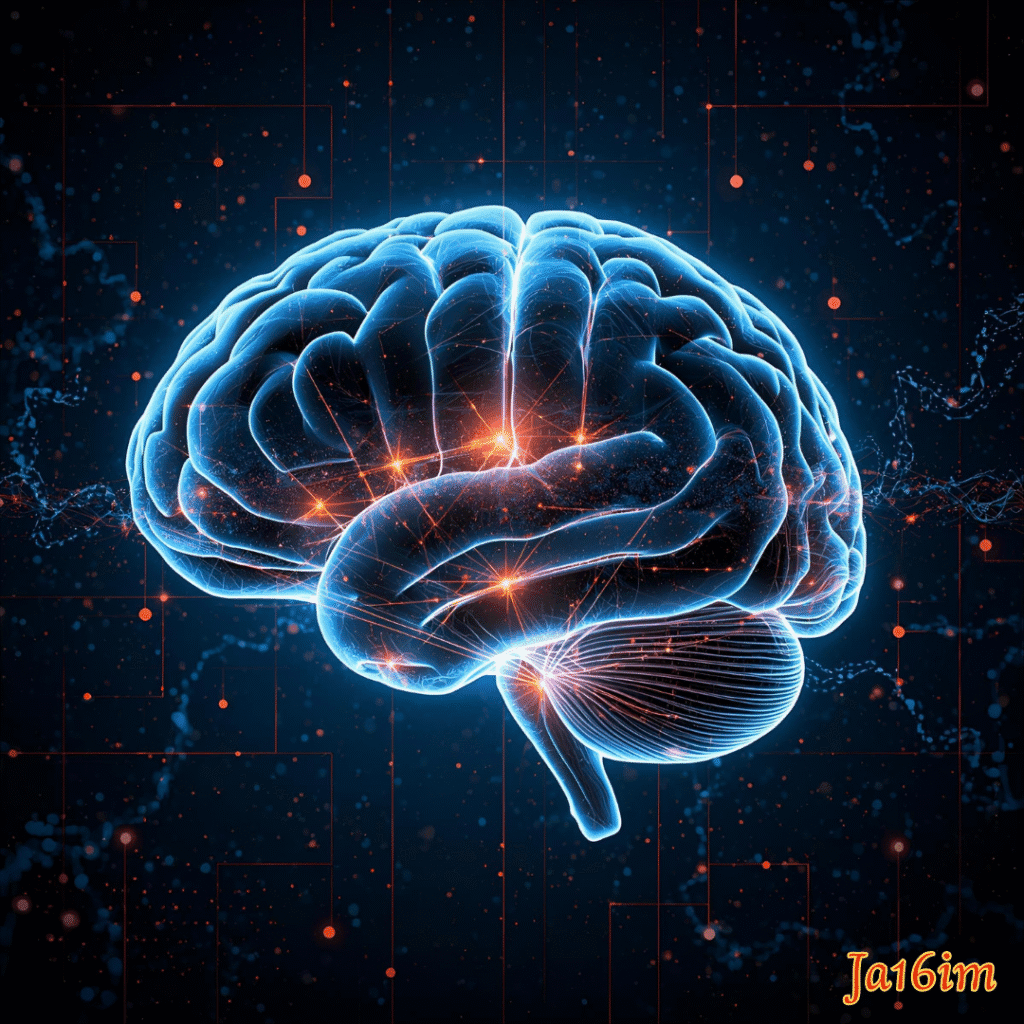
If biological evolution is slow, technological evolution offers us an accelerated path toward a functionally “bigger and faster mind.” This is the era of the **Extended Mind**:
- Neuro-Interfaces: Brain-Computer Interfaces (BCIs), such as those pioneered by Neuralink, represent the next qualitative leap. This technology aims to merge AI and the global information network directly with the cerebral cortex, granting the mind processing power and information retrieval speed that far exceed biological memory limits.
- The Extended Mind Hypothesis: This concept suggests that our digital tools (phones, search engines) are not just instruments, but actual extensions of our cognitive functions. We rely on them for memory, planning, and calculation. This means our *effective* mind is already bigger and faster, but it has become hybrid.
✨ Power in Consciousness, Not Speed: The Philosophical Divide
In conclusion, the hybrid evolution raises a crucial philosophical question: Is a “faster” mind necessarily better?
- Meaning vs. Data: A faster mind may be better at processing data, but not necessarily better at manufacturing meaning. Human power lies in the capacity for feeling, empathy, and asking existential questions—qualities not measured by speed.
- Conscious Choice: The future of the mind depends on our conscious decision about *what* we choose to inject into this extended brain. Will we use speed to increase awareness and connection, or to amplify distraction and empty algorithms?
The future of the human mind is not in the biological brain alone, but in how we integrate internal consciousness (empathy, wisdom) with external tools (speed, data). This is the most important chapter in the coming evolution.
Remember: Meaning is the journey itself, not the destination. And the meaning we create is what immortalizes us.
Writing and Contemplation: Jassim Alsaffar
Digital Identity: Ja16im
A contemplative artist and philosophical writer exploring the symbolism of perception and meaning through digital art, bilingual books, and contemplative scientific articles.
- Limits of Human Cognition: Why Truth May Be Beyond the Mind
- Limits of Human Cognition: Cognitive Closure and Hidden Reality
- The Event Horizon of the Mind: What the Brain Cannot Imagine
- Beyond Earth: Can Humanity Become an Interstellar Species?
- The Final Sunset: What Happens to Humanity When the Sun Dies?
