
Identity: A Mirror of Consciousness Between Science and Reflection
“Identity is not what we say about ourselves, but what echoes within us when we are silent.”
Since the dawn of human introspection, identity has remained an open question: Who am I? But this question cannot be answered with a word—it must be explored through layers of perception, memory, and relationship. This article dives into the concept of identity from both scientific and philosophical perspectives, revealing how the self is formed, reshaped, and sustained.
1. Identity as a Neural Process
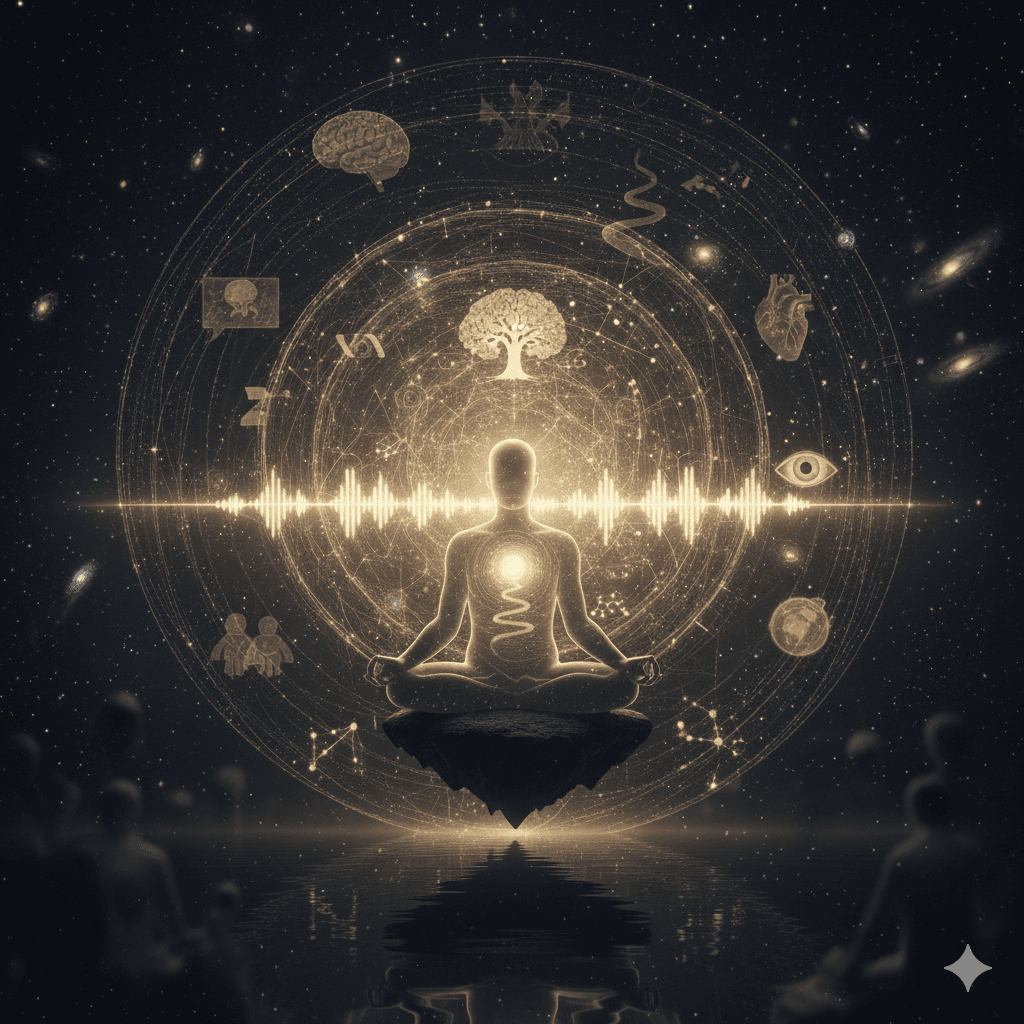
Neuroscience does not treat identity as a fixed entity, but as a dynamic process. The brain does not store the “self” in a single location—it reconstructs it continuously through neural networks involving the prefrontal cortex, hippocampus, and amygdala. These regions interact to generate a sense of continuity, uniqueness, and belonging.
From this view, identity is not an essence, but a neural narrative renewed with every experience.
2. Memory and Identity: A Fragile Bond
Memory plays a central role in shaping identity, yet it is not precise. We do not recall the past as it happened, but as we need to remember it. This means identity is not a record—it is a continuous reinterpretation.
In cases like amnesia or dissociative identity disorder, we witness how the self can fragment or be entirely restructured, confirming that identity is not fixed but malleable and vulnerable.
3. Identity in Philosophy: The Self as Awareness
From Descartes to Hume, Kant to Parfit, the question of identity has remained central in philosophy. Are we a single continuous self, or a stream of mental states? Modern philosophy leans toward viewing identity as a cognitive structure rather than a metaphysical essence.
Identity, then, is not something we possess—it is something we experience and reinterpret.
4. Social Identity: The Other as Mirror
Identity does not form in isolation. We define ourselves through the other: language, culture, belonging, and even the gaze of others all reshape us.
Social psychology shows that identity shifts with context, and we reveal different facets of ourselves depending on the situation. This means identity is not entirely individual—it is a mutual relationship.
5. A Contemplation: Are We What We Think?
In moments of silence, when we do not define ourselves by role, name, or affiliation—what remains? Perhaps true identity is not what we declare, but what remains alive within us when all voices fade.
Identity is not an answer—it is an ongoing question. Not a definition, but a journey into the essence of meaning.
Written and Contemplated by: Jassim Al-Saffar
Digital Signature: Ja16im
A contemplative artist and philosophical author exploring the symbolism of perception, time, and meaning through digital art, bilingual books, and reflective essays.
- Limits of Human Cognition: Why Truth May Be Beyond the Mind
- Limits of Human Cognition: Cognitive Closure and Hidden Reality
- The Event Horizon of the Mind: What the Brain Cannot Imagine
- Beyond Earth: Can Humanity Become an Interstellar Species?
- The Final Sunset: What Happens to Humanity When the Sun Dies?
