
Memory: Pain as an Evolutionary Compass
We often assume that memory is like an archive where events are stored in equal chronological order
But the biological and psychological reality is entirely different. Memory is not a neutral recorder; it is a deeply biased entity controlled by emotions.
While we wish memories of joy and tranquility would remain the clearest
We find that painful and traumatic experiences are often etched into memory as if engraved in stone, difficult to erase.
The question, “Why do we remember pain more?” is fundamentally a question about the **priority of survival** that the brain places above all else.
What determines the strength of a memory is not the event, but the intensity of the emotion tied to it.
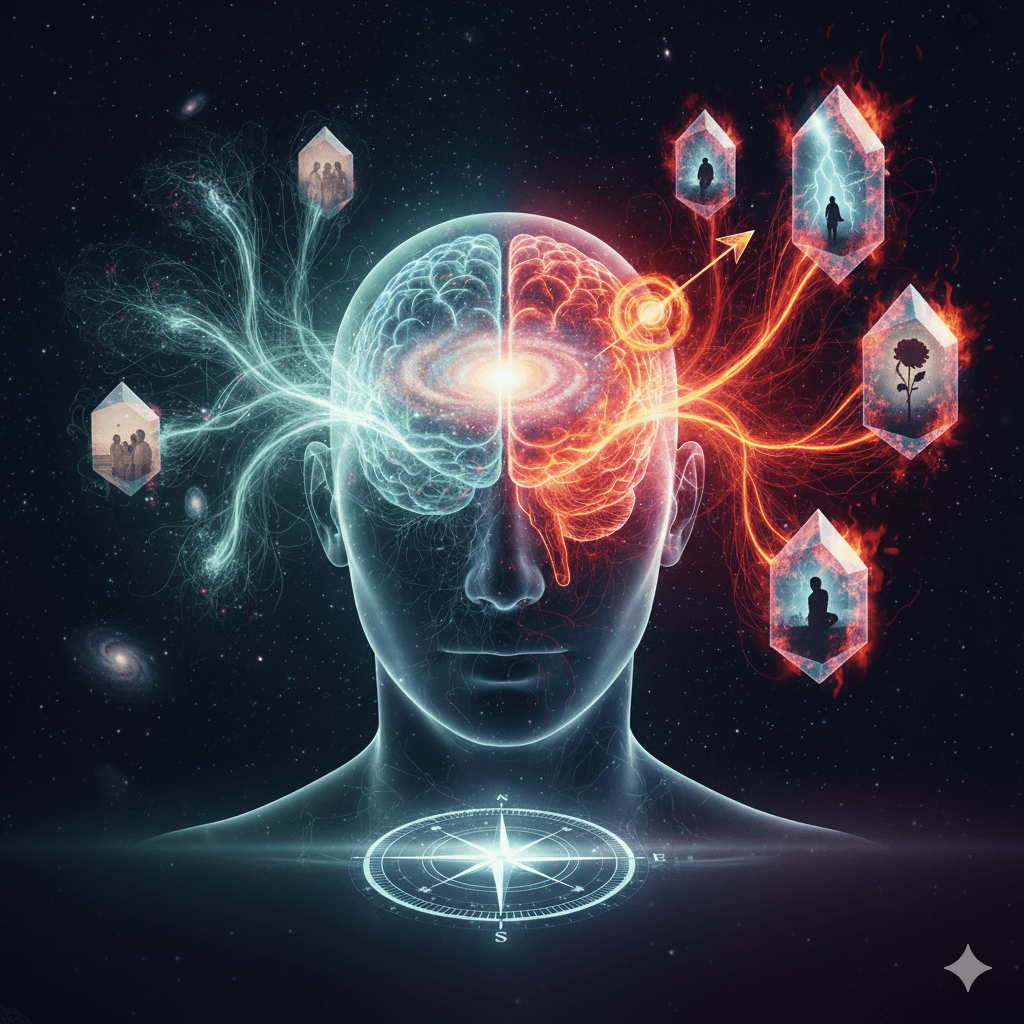
Pain – Memories
🔬 The Neural Pact: Amygdala and Hippocampus
The extraordinary strength of negative emotional memory lies in the collaboration between two vital regions in the brain that operate as a team during crises:
- The Amygdala: This is the emotion processing center, particularly for fear and anxiety. When exposed to a painful or threatening event, the Amygdala fires up and releases neural signals that stimulate the secretion of stress hormones like **Adrenaline and Cortisol**.
- The Hippocampus: This region is responsible for encoding new memories and storing them as narrative memories. When Cortisol floods the brain, it gives the Hippocampus an urgent command: “This event is vital. Record it with extreme clarity.”
This pact ensures that any event carrying high emotional value
(whether negative like pain, or positive like intense joy) will be encoded more deeply.
However, because negative emotions are frequently linked to potential threats
They are reinforced with the highest priority because they serve as the **compass of survival**
That prevents the mistake from recurring.
⚔️ Pain as an Evolutionary Priority: Fear Ensures Continuity
From an evolutionary perspective, this phenomenon is justified only by survival. In an environment dominated by danger, a human’s ability to instantly recall the source of pain or threat (such as an accident or betrayal) is what guarantees their survival and prevents the recurrence of a deadly situation:
- The Early Warning System: Painful memory acts as an internal alarm system. Merely recalling the pain (even psychological pain) triggers a physical response (tension, fear) intended to inhibit the behavior that led to that pain in the past.
- Fragmentation of Pleasant Memory: In contrast, positive experiences do not require the same focus for encoding. Happiness and tranquility are often flowing experiences that do not need to be precisely detailed for survival, which is why our happy memories may seem less sharp or more blurred over time compared to the stark “snapshots” of pain.
✨ The Transformation of Memory: The Role of Innate Positivity Bias
Although we strongly encode pain, the brain does not allow these memories to destroy our existence, and here the philosophical and healing aspect of memory emerges:
- The Fading Effect: Over time, the strength of the emotional bond to a negative memory gradually decreases, while positive memories tend to flourish. This is known as the **”emotional fading effect,”** and it is a necessary process for psychological recovery.
- Positivity Bias (Rosy Retrospection): With age and maturity, most individuals tend to recall the past more positively. This innate bias allows us to move forward and confirms that we are not slaves to our painful past.
In conclusion, we remember pain more not as a punishment, but as a lesson in the art of survival. The ability to transform painful memory from a threat into a source of strength is the highest level of consciousness. Pain is merely raw material; the meaning we assign to it is what determines whether that memory will be a chain or a compass guiding us toward deeper growth.
Remember: Meaning is the journey itself, not the destination. And the meaning we create is what immortalizes us.
Writing and Contemplation: Jassim Alsaffar
Digital Identity: Ja16im A contemplative artist and philosophical writer exploring the symbolism of perception and meaning through digital art, bilingual books, and contemplative scientific articles.
- Limits of Human Cognition: Why Truth May Be Beyond the Mind
- Limits of Human Cognition: Cognitive Closure and Hidden Reality
- The Event Horizon of the Mind: What the Brain Cannot Imagine
- Beyond Earth: Can Humanity Become an Interstellar Species?
- The Final Sunset: What Happens to Humanity When the Sun Dies?
