
The Stranger in the Mirror: The Neuroscience of Depersonalization
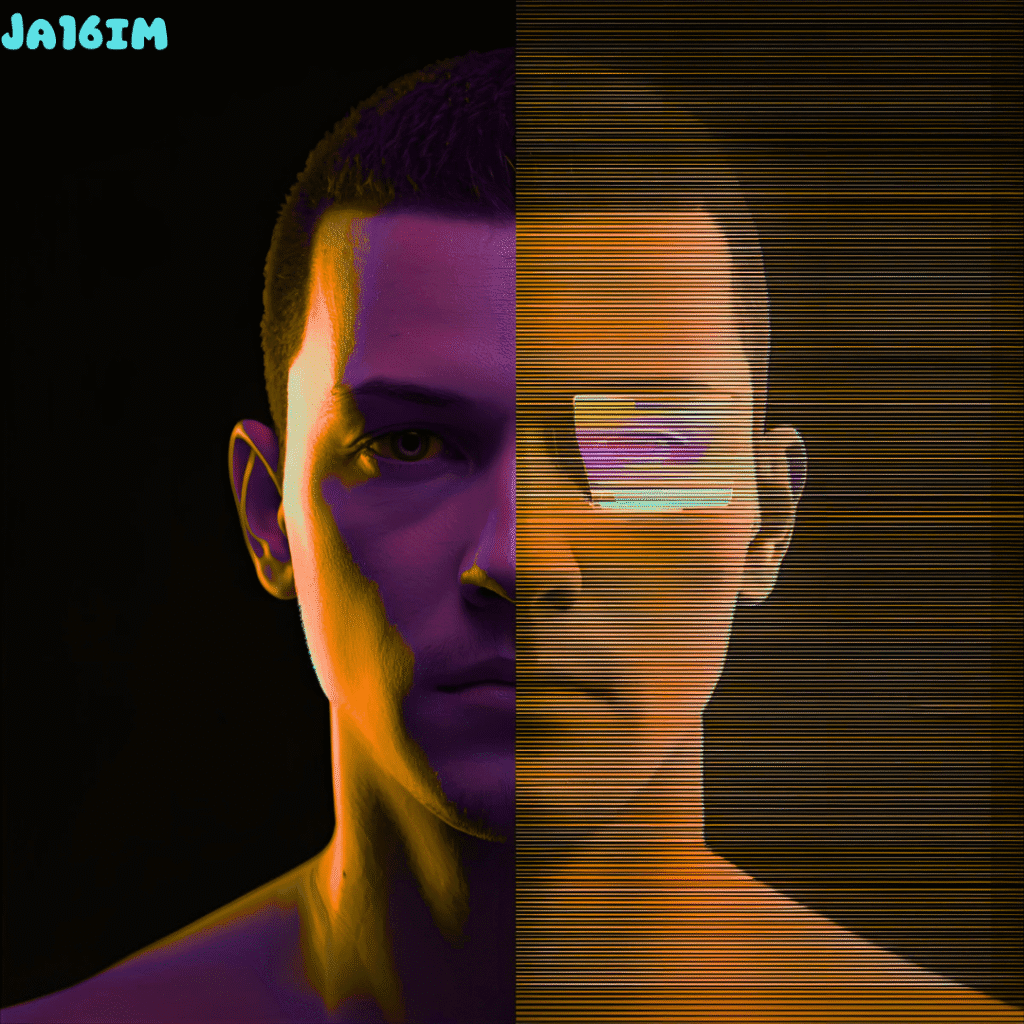
You wake up one day and look in the mirror. You see a face you know perfectly well, yet you do not feel it is “you.” Your hand moves, but it feels as though a machine is operating it. The world around you appears flat, two-dimensional, as if you are watching your own life through a thick pane of glass.
This state, known as Depersonalization, is neither madness nor a poetic metaphor. It is a precise neurological response—a biological safety switch your brain decides to flip when reality becomes “too much to bear.” But how exactly does the brain turn off the “Self”?
1. Emotional Anesthesia: When the Mind Numbs You
In normal situations involving danger or stress, the Amygdala lights up with fear and anxiety. However, during depersonalization, the opposite occurs.
Brain imaging studies reveal that the Prefrontal Cortex (specifically the VLPFC)—responsible for control and logic—becomes hyperactive to inhibit the Amygdala completely. Your brain decides that emotion (even pain) is currently a threat, so it cuts the wire. The result? You see the danger, you understand the situation, but you feel nothing. You become a neutral, cold observer. It is forced emotional anesthesia to ensure the system keeps running.
2. The Isolated Island: Disconnecting from the Body
The sense that we “are” ourselves and that we inhabit our bodies comes from a brain region called the Insula. This area is responsible for “Interoception”—receiving signals from the heart, gut, and skin, and integrating them to generate the feeling of “I am here.”
During a depersonalization episode, connectivity between the Insula and conscious awareness weakens. Your body sends signals, but the brain refuses to integrate them into the image of the “Self.” This explains why sufferers feel like “ghosts” or “robots.” The mechanical parts are working, but the pilot has lost contact with the sensory dashboard.
3. GPS Malfunction (The TPJ)
Why do some feel they are floating outside their bodies or standing behind their own heads? The cause lies in the Temporoparietal Junction (TPJ).
This region is responsible for integrating visual and somatic information to locate you in space. When the TPJ malfunctions due to extreme stress, the brain fails to match what your eyes see with what your body feels. The result is a processing error that makes you feel “geometrically” displaced, as if the center of your consciousness has shifted outside your skull.
4. Colorless Memory
Memory is also affected. You remember events, but you feel they happened to someone else.
This occurs because the Hippocampus (responsible for facts) is disconnected from the emotional centers. Memory is stored as dry “Data,” stripped of the emotional coloring that makes a memory “personal.” Your life becomes a novel you read, rather than an experience you lived.
Conclusion: The Shield That Became a Prison
Understanding the biology behind “disconnecting from oneself” removes the horror and mystery. It is not a collapse of the mind; fundamentally, it is a survival mechanism evolved to protect us during overwhelming trauma (so pain or terror doesn’t shatter us).
The problem arises when the brain gets stuck in this “Emergency Mode” longer than necessary, turning the shield that protects you from pain into a prison that prevents you from living. Returning to the self begins when the brain is convinced the danger has passed, and that it is safe enough to feel once again.
Writing & Reflection: Jasem Al-Saffar
Digital Identity: Ja16im
A meditative artist and philosophical writer exploring the symbolism of perception and meaning through digital art, bilingual books, and speculative scientific essays.
- Limits of Human Cognition: Why Truth May Be Beyond the Mind
- Limits of Human Cognition: Cognitive Closure and Hidden Reality
- The Event Horizon of the Mind: What the Brain Cannot Imagine
- Beyond Earth: Can Humanity Become an Interstellar Species?
- The Final Sunset: What Happens to Humanity When the Sun Dies?
