
Limits of Human Cognition: Cognitive Closure and Hidden Reality
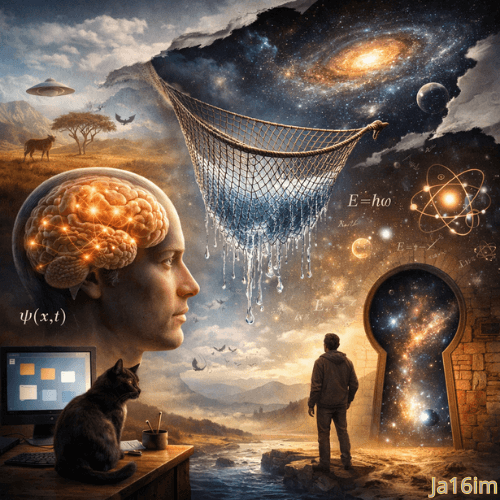
The limits of human cognition raise a difficult question: are there truths that exist beyond what the human mind is structurally able to grasp?
Truths Too Big for Heads
Are There Ideas Structurally Beyond Our Grasp?
On Cognitive Closure and the Limits of the Human “User Interface”
Can a fishing net catch water?
The answer is no—not because water does not exist, but because the very structure of the net allows it to pass through. This simple analogy leads us to one of the most unsettling questions in philosophy and science: Is the human mind merely a “net” designed to capture certain kinds of truths, while deeper realities slip through the holes of our perception?
We tend to assume that every mystery in the universe is solvable, given enough time, data, and intelligence. Yet evolutionary biology introduces a sobering constraint. The human brain did not evolve to understand reality in its totality; it evolved to solve problems of survival, reproduction, and navigation in a very specific environment. Truth, in the philosophical sense, was never evolution’s primary objective.
This does not mean the brain is incapable of discovering deep truths—but it does suggest that our access to reality may be selective rather than complete.
As one might observe: just as a cat will never understand calculus no matter how closely it watches you write it, there may be physical laws fully present before us that our brains lack the internal “software” required to decode.
The “User Interface” Theory and Hidden Reality
Cognitive neuroscientist Donald Hoffman proposes a provocative idea: what we perceive is not reality itself, but a user interface shaped by natural selection. Consider your computer desktop. A blue rectangular icon represents a file—but the file inside the computer is neither blue nor rectangular. The icon is a useful fiction, designed to help you act efficiently while hiding overwhelming complexity.
Hoffman suggests that space, time, objects, colors, and shapes may function in the same way: perceptual icons that allow us to survive, not transparent windows onto objective reality.
Importantly, this idea is not a scientific consensus, nor does it claim that reality is an illusion. Rather, it is a theoretical framework proposing that evolution favors fitness over truth—interfaces that work, not representations that reveal what reality is “in itself.”
Here, the connection to Immanuel Kant becomes unavoidable. What Kant called the Ding an sich—the thing-in-itself—may exist independently of our perceptions, yet remain inaccessible to them. If Hoffman is even partially correct, then what we experience as reality may be a highly compressed, biologically optimized translation of something fundamentally alien to our intuitions.
Cognitive Closure
Philosopher Colin McGinn introduced the concept of cognitive closure: the idea that every intelligent species has intrinsic limits imposed by its biological constitution. Certain problems are simply closed to certain kinds of minds.
To a dog, political theory is not merely unknown—it is cognitively inaccessible. The neural architecture required to conceptualize it is absent.
The unsettling question, then, is this: Why do we assume that humans are exempt from such limits? Why do we believe our cognitive ceiling, unlike that of every other species, does not exist?
Problems such as the nature of consciousness, the origin of the universe, or the ultimate structure of reality itself may lie beyond our biological reach—not because they are meaningless, but because our mental apparatus is not designed to accommodate them. Just as color lies beyond a bat’s echolocation, certain truths may lie beyond human cognition.
The Quantum Case: Mathematical Truth Without Intuition
Richard Feynman once remarked, “I think I can safely say that nobody understands quantum mechanics.” The statement is revealing. We can use quantum theory with astonishing precision. Its equations power modern electronics, nuclear energy, and emerging quantum technologies. Yet we struggle—perhaps fundamentally—to intuit what those equations describe.
Particles existing in superposition, entanglement across space, non-local correlations—these ideas resist the structures of human intuition shaped by a macroscopic, classical world.
This does not prove that such concepts are forever inaccessible to understanding. But it does illustrate a crucial distinction: a theory can be mathematically correct and empirically successful while remaining cognitively resistant to human intuition.
Here, we glimpse a truth that is operationally usable, yet phenomenologically opaque—a possible example of knowledge brushing against the edges of our cognitive net.
✦ ✦ ✦
Humility Before the Unknown
To acknowledge that some ideas may be “larger” than the brain is not a surrender to ignorance. It is an invitation to intellectual humility. It loosens the grip of human exceptionalism and reminds us that we are participants in reality, not its arbiters.
The universe may be filled with symphonies of truth playing at immense volume—but possessing ears does not guarantee the ability to hear every frequency.
Conclusion: Peering Through the Keyhole
We are not the masters of truth; we are its guests. The human mind is a remarkable instrument, but it remains an instrument with limits. Perhaps the deepest mystery is not that the universe is strange, but that it allows us to glimpse even a fragment of it at all.
What lies beyond that fragment may not be false, unknowable, or meaningless—only structurally beyond the reach of the net we call the human mind.
Digital Identity: Ja16im
- Limits of Human Cognition: Why Truth May Be Beyond the Mind
- Limits of Human Cognition: Cognitive Closure and Hidden Reality
- The Event Horizon of the Mind: What the Brain Cannot Imagine
- Beyond Earth: Can Humanity Become an Interstellar Species?
- The Final Sunset: What Happens to Humanity When the Sun Dies?
