
The Era of Great Solitude: How Will the Universe Look in 100 Billion Years?
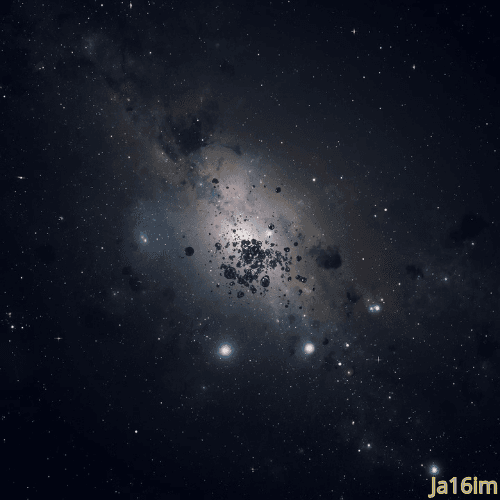
When Galaxies Vanish and Civilizations Forget the Big Bang
We live today in the “Golden Age” of astronomy. Our sky is teeming with galaxies, we can detect light from the dawn of time, and we see traces of the Big Bang everywhere. But this rich view will not last forever. The universe is changing, not just in its structure, but in the “information” it allows its inhabitants to access.
If we jump 100 billion years into the future, we won’t find a dead universe, but we will find a terrifyingly “lonely” one. The question here is not: Will life exist? But rather: What will that life know about its own reality?
“In the distant future, civilizations will gaze into the sky and see nothing but pitch darkness surrounding their own galaxy. They will believe they are alone, that their universe is static and eternal, and they will never believe that we were here to witness the Big Bang.”
The Birth of “Milkomeda”: A Single Cosmic Island
The first radical change our cosmic neighborhood will witness is the disappearance of the Andromeda Galaxy and our own Milky Way. Gravity will pull them into a violent dance, merging them to form a giant elliptical galaxy scientists call “Milkomeda.”
The night sky will change; the beautiful spiral arm we see today will vanish, replaced by a dense halo of ancient red stars. But the real catastrophe lies not in the merger, but in what happens outside this island.
The Great Escape: The End of Cosmology
Due to “Dark Energy,” the expansion of the universe is accelerating wildly. After 100 billion years, all other galaxies will be moving away from us faster than the speed of light. They will vanish behind the “Cosmic Horizon,” never to be seen again.
Here lies the philosophical tragedy: Civilizations arising in that era will possess no evidence of the Big Bang. They won’t see galaxy expansion (because the galaxies are gone), and they won’t detect the Cosmic Microwave Background (because it will have faded). They will build “correct” scientific theories based on their observations, concluding that the universe consists only of their single galaxy, static and eternal. Their science will be precise, but their conclusion will be fundamentally wrong.
The Future Paradox: Scientists Lawrence Krauss and Robert Scherrer point out that we live in the only time in cosmic history when we can understand the origin of the universe. In the future, all evidence will be erased. We are the sole witnesses to the truth before the universe draws its curtains.
✦ ✦ ✦
The Aesthetics of Emptiness: Does Solitude Have Meaning?
Despite this isolation, the universe will possess a different kind of beauty. Red stars (red dwarfs) will live for trillions of years, providing stable warmth to their planets. Life in that era might be slower, wiser, and unconcerned with conquering outer space because, simply put, there is no “outer space” to reach.
Perhaps those civilizations will turn inward, exploring the depths of consciousness and matter rather than vast dimensions. Maybe cosmic isolation is the necessary condition for achieving absolute inner peace.
Conclusion: Gratitude for the Present Moment
Reflecting on the universe 100 billion years from now fills us with a deep sense of gratitude for our current moment. We are lucky to exist in the Age of Transparency, a time when the universe still whispers the secrets of its beginning.
We are the guardians of cosmic memory. Our responsibility is to record this story—the story of a universe that once bustled with life and galaxies—before the long night of isolation sets in.
Writing & Reflection: Jassim Al-Saffar
Digital Identity: Ja16im
A meditative artist and philosophical writer exploring the symbolism of perception and meaning through digital art, bilingual books, and speculative scientific essays.
- Limits of Human Cognition: Why Truth May Be Beyond the Mind
- Limits of Human Cognition: Cognitive Closure and Hidden Reality
- The Event Horizon of the Mind: What the Brain Cannot Imagine
- Beyond Earth: Can Humanity Become an Interstellar Species?
- The Final Sunset: What Happens to Humanity When the Sun Dies?
