
The Final Sunset: What Happens to Humanity When the Sun Dies?
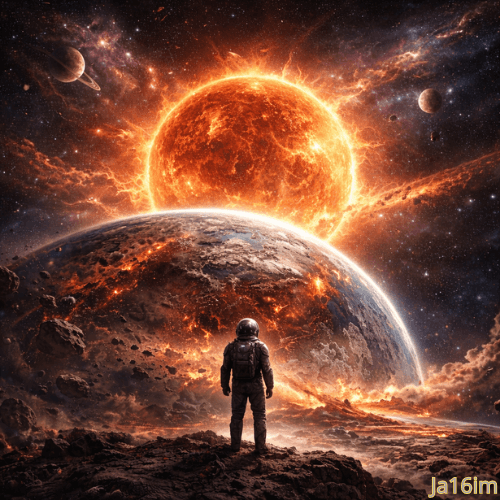
A Journey from the Great Expansion to the Silent White Dwarf
In the human psyche, the Sun has always stood as a symbol of eternity—an inexhaustible fount of warmth and vitality. Yet, physics whispers a different story. Our Sun is but a massive nuclear furnace, and like all furnaces, its fuel is finite. One day, the hydrogen will run dry, and the Sun will begin its final, funeral dance.
This reflection is not merely about the end of the world; it is about the resilience of the human spirit in the face of cosmic transience. How does our destiny unfold when the very star that birthed us decides to consume us?
“We are stardust watching its own destiny in the mirror of the sky. The death of the Sun is not an ending of existence, but the ultimate transformation of the matter that once shaped our dreams.”
Phase I: The Boiling of Oceans (In 1 Billion Years)
Long before the Sun’s actual demise, its temperature will begin to rise. In approximately one billion years, solar luminosity will increase by about 10%. This may seem negligible, but it is enough to evaporate Earth’s oceans and turn our planet into a barren twin of Venus.
This brings us to a speculative crossroad: Will humanity remain tethered to its first home? It is likely that—should we survive our own discords—we will have already migrated to the moons of Jupiter or Saturn, or perhaps even to other star systems, leaving Earth as a scorched memory in cosmic history books.
Phase II: The Red Giant and Earth’s Embrace
In about 5 billion years, the Sun’s envelope will expand to terrifying proportions, transforming into a Red Giant. It will swell to swallow Mercury, Venus, and possibly Earth itself. At this stage, having exhausted its hydrogen core, the Sun begins burning helium.
For a distant human observer—perhaps from a colony on Pluto—the Sun will appear as a colossal crimson disc filling half the sky, its light dim and mournful, yet possessing a devastating power.
The Scientific Reality: As a Red Giant, the Sun will lose a significant portion of its mass through powerful solar winds. This loss of gravity might push Earth’s orbit slightly outward, but this “escape” is unlikely to save the planet from being sterilized or vaporized.
✦ ✦ ✦
The Aftermath: The White Dwarf and Cosmic Serenity
Ultimately, the Sun will shed its outer layers into space, leaving behind a colorful, hauntingly beautiful “planetary nebula.” At its heart will remain the compressed core: a White Dwarf. A star the size of Earth but with unimaginable density, cooling slowly over trillions of years into a dark ember.
Conclusion: Beyond the Void
The death of our Sun is a reminder that everything in this universe has a lifecycle. We, through our consciousness, represent the moment the universe became aware of its own mortality. Perhaps our fate is to carry the torch of awareness to younger stars, immortalizing the story of the blue planet that was once our cradle under a golden sun that is no more.
Writing & Reflection: Jassim Al-Saffar
Digital Identity: Ja16im
A meditative artist and philosophical writer exploring the symbolism of perception and meaning through digital art, bilingual books, and speculative scientific essays.
- Limits of Human Cognition: Why Truth May Be Beyond the Mind
- Limits of Human Cognition: Cognitive Closure and Hidden Reality
- The Event Horizon of the Mind: What the Brain Cannot Imagine
- Beyond Earth: Can Humanity Become an Interstellar Species?
- The Final Sunset: What Happens to Humanity When the Sun Dies?
