
The Cosmic Mirror: Why Do We Always Imagine Aliens in Our Own Image?
Between Anthropocentrism and the Constraints of Evolution
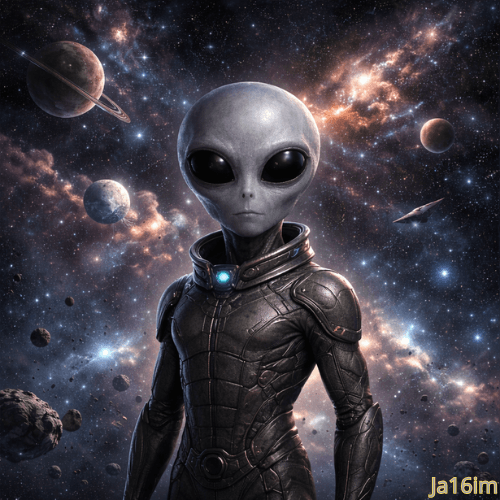
An oversized head, almond-shaped eyes, and a slender bipedal frame. This is “The Grey”—the stereotypical image that has occupied our collective imagination for decades. But in a vast universe containing billions of planets with extreme environments, why does our mind insist on confining “aliens” to a distorted human mold?
Our inability to imagine truly alien life forms is not just a lack of creativity; it is a profound struggle between anthropocentrism and our limited understanding of the laws of physics and biology.
“We are not searching for extraterrestrials in the sky; we are searching for ourselves with different features. The alien in our imagination is the ‘Other’ we need to define our terrestrial identity.”
Psychological Projection: Fearing the Absolute Stranger
From a psychological perspective, the human brain is hardwired for anthropomorphism. We find faces in clouds, assign personalities to pets, and even talk to our machines. Seeing an alien that shares our bilateral symmetry (a head, two eyes, two arms) makes the experience psychologically digestible.
If we imagined an alien as an intelligent gas or a conscious oil slick, we would lose the ability to communicate with it emotionally. We need eyes to read intent and hands to understand action. Projecting a humanoid form is a cognitive defense mechanism that reduces the terror of the unknown, turning it into a “strange neighbor” rather than an “incomprehensible entity.”
Biological Probability: Convergent Evolution
Scientifically, there is a hypothesis known as “Convergent Evolution.” It suggests that nature’s solutions to physical problems tend to repeat. If life requires technological intelligence, it might necessitate stereo vision (to perceive depth), manipulative appendages (like thumbs), and a brain protected in a skull.
Consequently, some scientists argue that aliens might resemble us not because we are special, but because our “design” is physically efficient for building technical civilizations. However, this view remains trapped within the “carbon-based” biology we know.
Scientific Note: Astrobiologists often warn against “Carbon Chauvinism”—the assumption that all life must be based on carbon and water. This bias restricts our imagination regarding life based on silicon, ammonia, or even star-born plasma.
✦ ✦ ✦
Breaking the Human Box
The truth may be far stranger than Hollywood can depict. Real extraterrestrials might not have a “face” at all, or occupy a physical space we recognize. They could be a collective consciousness breathing through gravitational waves, or entities existing in dimensions beyond our five senses.
Conclusion: A Meeting with the Self
When we ask, “What will an alien look like?”, we are truly asking, “Who are we in this universe?”. The repetition of the human image in our alien lore proves we are still in our “cosmic childhood,” believing our form is the pinnacle. Perhaps the moment we encounter a truly “alien” life form will be the moment we realize, for the first time, how limited our perception of beauty and existence has always been.
Writing & Reflection: Jassim Al-Saffar
Digital Identity: Ja16im
A meditative artist and philosophical writer exploring the symbolism of perception and meaning through digital art, bilingual books, and speculative scientific essays.
- Limits of Human Cognition: Why Truth May Be Beyond the Mind
- Limits of Human Cognition: Cognitive Closure and Hidden Reality
- The Event Horizon of the Mind: What the Brain Cannot Imagine
- Beyond Earth: Can Humanity Become an Interstellar Species?
- The Final Sunset: What Happens to Humanity When the Sun Dies?
