
Not Just a Void: Why Does the Universe Whisper to Us?
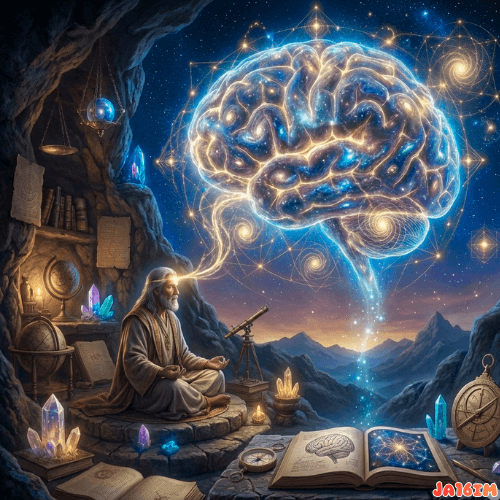
Stand under a clear winter sky and look up. What do you feel? If we strip the scene of its physical equations, what remains is not merely burning rocks and cold gas. There is a “heaviness,” a palpable presence that fills the chest. It is a mysterious sensation that this vast emptiness is not truly empty, but is somehow imbued with “something.”
This intuition is not born of a fleeting romantic moment, nor is it a modern invention. It is a feeling that has accompanied humanity since the first Ibex was painted on a cave wall. From the Maya, who saw time as a living entity, to the Stoics who believed in the “Logos” (the cosmic reason). Why does the human brain, biologically designed for survival, eating, and reproduction, insist on feeling that the universe is “alive” or “aware”?
“We do not look at the universe as strangers peeping through a window, but as a child looks into its mother’s eyes—seeking a mutual recognition of existence.”
The Hidden Soul: The Return of Panpsychism
Historically, ancient civilizations did not treat matter as “dead.” In both Eastern and Western philosophies, there was a belief in the Anima Mundi or “Soul of the World.” The universe was perceived as a single, interconnected fabric of consciousness.
Surprisingly, modern science, after centuries of strict materialism, is beginning to revisit this idea through the back door. Contemporary philosophers like David Chalmers and prominent neuroscientists are seriously debating Panpsychism. This theory suggests that consciousness is not merely a byproduct of the brain but a fundamental property of matter, like mass and charge. This explains why we feel the universe is “more than just a void”; perhaps we are sensing the “proto-consciousness” scattered in every atom.
The Physics of Emptiness: The Silent Fullness
Even if we set philosophy aside, modern physics confirms our intuition: The void is not empty. Quantum mechanics tells us that what we call “vacuum” is actually a noisy, crowded theater of energy fields and virtual particles popping in and out of existence in fractions of a second.
There are fields that permeate the entire cosmos (like the Higgs field), giving particles their mass. When we feel that space is “full,” we are not hallucinating. We are sensing, in some abstract way, a profound physical truth: There is no such thing as “nothing.” The universe is a continuous weave, and we are merely ripples in this quantum ocean.
The Neurobiology of Awe
Why did evolution design our brains to feel this connection? Brain imaging studies show that when humans experience “Awe” before a vast cosmic or natural scene, activity in the “parietal lobe” decreases. This is the region responsible for drawing the boundaries between the “Self” and the “External World.”
When this part of the brain quiets down, psychological boundaries dissolve, and we physically feel as though we have melted into the cosmos. This is not a glitch; it is an evolutionary mechanism, perhaps originally meant to foster group cohesion, but it has gifted us a side effect: the ability to taste “oneness.” We are biologically programmed to transcend ourselves.
The Echo of Ancient Music
Pythagoras heard what he called the “Music of the Spheres.” Mystics spoke of the “Unity of Witness.” Today’s astronauts speak of the “Overview Effect.” The labels differ, but the experience is identical.
This feeling that the universe is “more than just a void” is an internal compass. It is a constant reminder that we are not a random accident occurring in a cold, dark place. It is an intuition whispering that we are “the universe experiencing itself,” and the void we see is not a barrier separating us from the stars, but the bridge that connects us to them.
Conclusion: Trusting the Intuition
The next time you look at the sky and feel that mysterious “presence,” do not dismiss it as poetic fancy. This feeling is the convergence of the deepest truths of physics with the deepest truths of consciousness. The universe is not a graveyard of dead rocks; it is, as our ancestors felt and as our equations hint, a living, unfolding poem—and we are the words by which it is read.
- Limits of Human Cognition: Why Truth May Be Beyond the Mind
- Limits of Human Cognition: Cognitive Closure and Hidden Reality
- The Event Horizon of the Mind: What the Brain Cannot Imagine
- Beyond Earth: Can Humanity Become an Interstellar Species?
- The Final Sunset: What Happens to Humanity When the Sun Dies?
