
The Sky is a Memory: Why We Live in the Universe’s Past
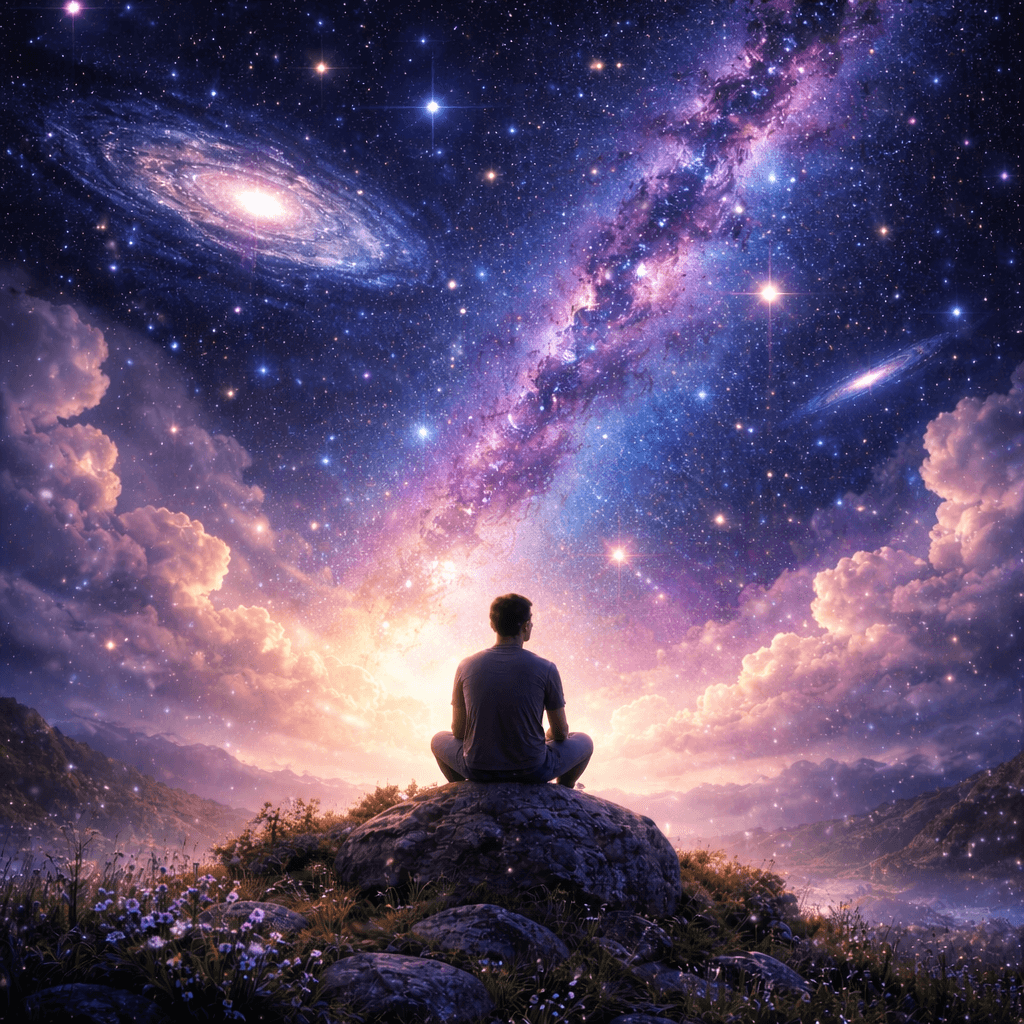
When you tilt your head back to contemplate the stars on a clear night, you are not just looking up; you are looking back. The sky above us is not a ceiling for the present, but a giant photo album of the ancient past. In the cosmos, to look into the distance is to look into time.
This simple scientific fact carries a profound philosophical charge: We do not see the universe as it is “Now,” but as it “Was.” The cosmic present is veiled from us by an impenetrable curtain, and the culprit is the lazy courier we call Light.
“We are time travelers using only our eyes. The deeper we gaze into space, the deeper we sink into the universe’s memory. Telescopes are not just magnifiers; they are time machines.”
The Speed of Light: The Courier with a Speed Limit
Light is the fastest thing in the universe, traveling at approximately 300,000 kilometers per second. While this seems instantaneous by our terrestrial standards, on the vast stage of the cosmos, light is frustratingly slow.
Moonlight takes 1.3 seconds to reach us. Sunlight leaves the Sun and arrives here 8 minutes later. This means if you look at the Sun, you are seeing its ghost as it appeared 8 minutes ago. If the Sun were to vanish right now, we wouldn’t know—and we wouldn’t feel the darkness—until 8 minutes later. We are always running late to reality.
Graveyard of Stars: Wishing on Ghosts
As we look further out, the time lag becomes staggering. The nearest star, Proxima Centauri, is seen as it was 4 years ago. The Andromeda Galaxy appears to us as it was 2.5 million years ago! The light entering your eye right now left Andromeda when our early human ancestors were just learning to use stone tools.
This posits a poetic and slightly haunting idea: Many of the stars twinkling in the night sky may have already died or exploded thousands of years ago, but the “news” of their death (their final light) has not reached us yet. We make wishes on the “ghosts” of stars that no longer exist. The night sky is a grand museum of history, not a live stream of the present.
Existential Isolation: Is “Now” an Illusion?
What does this mean for our concept of “Now”? If we cannot see anything in its true moment, does the present really exist?
Einstein and Relativity tell us that “Now” is a local illusion. There is no universal “Now” shared by everyone. Every point in the universe has its own time, isolated from others by the distance of light. We live in our own time bubble. Even the person sitting next to you is seen in the past (by a nanosecond), because light needs time to travel from their face to your eyes.
Conclusion: The Blessing of the Delay
This “cosmic lag” might seem like a design flaw, but it is actually the greatest gift to science and the soul. If light were instantaneous, we would never know how the universe began.
Thanks to this slowness, we can look to the edge of the universe and see the “Big Bang” and our history being written. The universe preserves its childhood in its farthest corners, allowing us—who arrived very late to the party—to watch the story of creation unfolding, scene by scene, written in ink made of light.
- Limits of Human Cognition: Why Truth May Be Beyond the Mind
- Limits of Human Cognition: Cognitive Closure and Hidden Reality
- The Event Horizon of the Mind: What the Brain Cannot Imagine
- Beyond Earth: Can Humanity Become an Interstellar Species?
- The Final Sunset: What Happens to Humanity When the Sun Dies?
